Industry Education
Can AI Predict Which Office Tenants Will Move? What the Research Says, and Five Questions for Any Vendor
By Casey Krueger, Founder & CEO, BrokerHQ · Published September 6, 2026 · 9 min read
Why is "predicts moves 24 months out at 80%" a claim to distrust?
Because the sentence omits the three things that would make it checkable: what counts as a move, what population the 80% is measured against, and which metric it is.
Take the definition problem first. The UK government's study of firm relocation, built on 233,561 observations from the national business register, found that 3.66% of firms changed postcode in a year, 1.11% changed district, and 0.47% moved between travel-to-work areas. Same firms, same year, an eightfold spread depending on what "move" means. A vendor that counts a suite change down the hall as a move will report a very different hit rate than one that counts only relocations across a submarket.
Then the denominator. At a strict physical-move rate near 0.5% per year, a random list of 100 companies contains half a mover. At the Federal Reserve's much broader definition (small employers reporting any move in the prior five years, annualized to roughly 5 to 6%), it contains five or six. A claimed 80% hit rate means 80 movers in 100 names, an enrichment of somewhere between 13 and 160 times over random, depending on which definition the vendor picked. Nothing in the relocation literature, or in the richer credit-risk and business-closure literatures, produces enrichment of that order at a 12-month horizon.
Then the metric. "80%" could be accuracy in a population where 95% of companies do not move (in which case predicting "nobody moves" scores 95%). It could be precision on ten hand-picked alerts. It could be recall after a permit was already filed. It could be a post-hoc broker confirmation rate. These are not interchangeable, and a vendor who will not say which one they mean has told you something.
What does the actual research show?
Less than the marketing implies. We could not find a single published study of firm relocation that reports an out-of-sample AUC, calibration curve or hit rate. The UK study does not. A Swiss registry panel of 392,463 firm-years does not. A 2026 working paper on public-company headquarters relocation, modeled on full financial statements, explains between 0.2% and 0.7% of the variance.
The closest commercial analogue is a 2018 Uppsala University thesis that tried to predict which tenants would vacate within a year, using actual lease contracts from a Swedish landlord. On the minority class (tenants who left) it reported precision of 0.56 and recall of 0.58. That is with the contracts in hand, a data advantage no public-records model will ever have.
On the renewal side, the largest US dataset we know of, an MIT thesis on 15,822 office leases, could explain under 5% of lease-level variance in the renew-or-leave decision. We covered that study and what it means for the "75% of tenants renew" assumption in our post on office renewal rates.
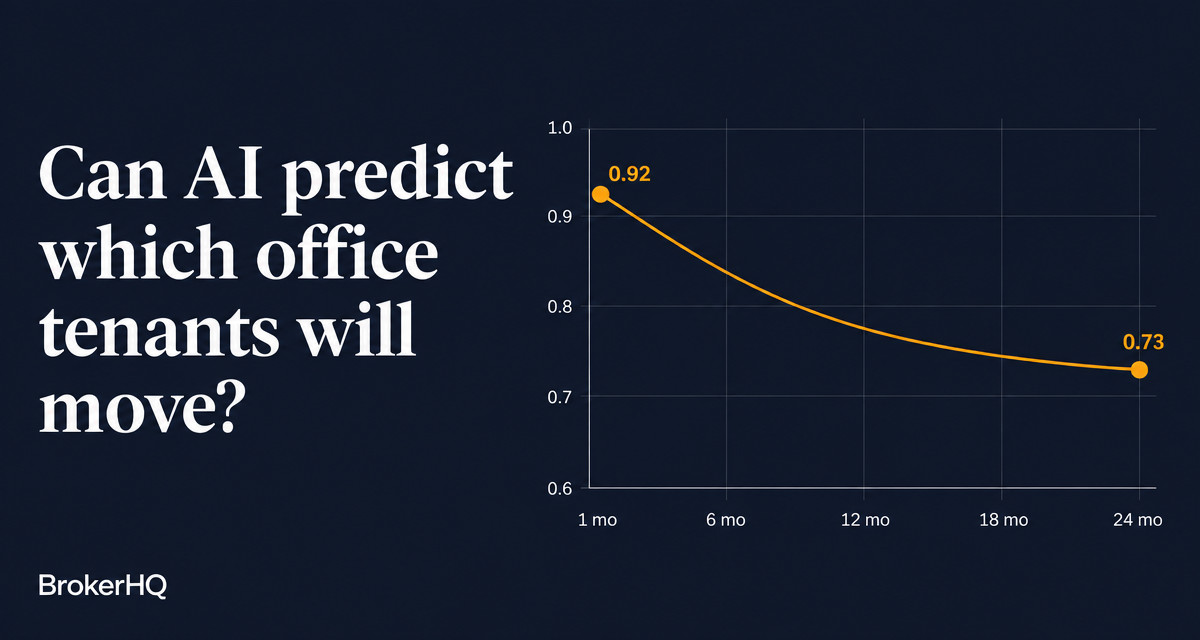
And information decays with horizon. The cleanest published curve comes from corporate bankruptcy prediction, a field with far richer inputs than a private King County tenant will ever expose. In Tian, Yu and Guo's 2015 study in the Journal of Banking and Finance, the best model's out-of-sample AUC was 0.920 one quarter ahead, 0.841 four quarters ahead, and 0.727 eight quarters ahead. Default is more observable than an office move and is modeled on audited financials. If that field loses a fifth of its discrimination between 12 and 24 months, a public-records move model at 24 months is closer to a coin flip than to a forecast.
Why does a lease expiration date beat the model?
Because conditional on a known expiration inside 12 months, the probability of the tenant leaving is already high. Highwoods Properties, an office REIT, told analysts on its Q2 2025 call that full-cycle retention with early renewals runs 60 to 65%, but that among leases expiring in the next 12 to 18 months, retention drops to 45 to 50% because tenants who intend to leave do not renew early. Flip those: a known near-term office expiration carries a 50 to 55% chance of a vacate.
No model built on permits, filings and headcount signals approaches 50% precision on named tenants. So wherever the expiration date exists, in CoStar, in CompStak, in a landlord's rent roll, in the broker's own notes, a date lookup with no model at all outperforms the best achievable predictor. Any vendor positioning its score against CoStar inside CoStar's covered universe will fail the first question from a broker who knows this.
Where does a predictor actually earn its keep?
In the coverage gap. The expiration date is not a universal field. It is well covered for institutional office in downtown Seattle and Bellevue and it is largely absent for the long tail: sub-5,000-square-foot suites, non-institutional landlords, unlisted buildings, the tenants in Georgetown and Kent and Lynnwood that no comp database ever captured. For those companies there is no date to look up at any price.
That is the honest market for a ranked list. A broker working the long tail at random, using the broad Federal Reserve definition, contacts roughly 17 to 20 companies to find one real space decision. The analogue literature supports a well-built public-records model cutting that by something like two to three times. That is a real product for a broker whose binding constraint is call hours. It is a meaningful improvement, not an oracle, and it should be sold as exactly that.
Two other places the numbers work. Deterministic events, meaning WARN notices, certificates of occupancy, business-license closures, are near-certain when they fire and simply rare. And licensed verticals such as clinics, restaurants and cannabis retail, where a state license application precedes a lease with high reliability, produce far higher enrichment inside the vertical than any general-purpose model does across the market. Both of those are signals, not predictions, and a vendor who blends them into a single "score" is hiding the fact that most of the score's lift comes from a handful of observed events.
What should a tenant-rep broker ask a vendor?
Five questions, in order.
- What counts as a move? Address-string change, suite move, relocation beyond the submarket, expansion, closure, or lease expiration? Ask for the definition in writing. If the vendor says "any of the above," the rate they quote is meaningless.
- What is the base rate in your test population, and how many events were in it? A hit rate without a denominator is a headline. A precision figure on fewer than a hundred events has a confidence interval wide enough to drive a truck through.
- Were the outcomes scored on a future vintage? The only test that counts is: rank the companies as of a date, wait 12 months, count who moved. Anything scored on data the model could have seen is a backtest with leakage.
- What is your coverage? Of the companies in my submarket, what share does the model even score, and what share of those resolve to a named decision-maker? A great score on 30% of the market is a 30% product.
- Does the score separate observed events from predictions? A WARN notice is a fact. A headcount-decline signal is an inference. If both roll into one number, ask what the number looks like with the facts removed.
A vendor who answers all five with numbers is worth a pilot. A vendor who answers with a case study is selling a case study.
The operator take
We are one of the vendors this post is about, and we have run the numbers on ourselves. BrokerHQ builds occupier-side signals for Seattle tenant-rep brokers, and the first thing our own feasibility work concluded is that the 24-month named-destination predictor is not buildable on public data, that no hit rate should be claimed, and that the product worth building is a ranked shortlist for the no-lease-date coverage gap plus a clean feed of observed events. We will not quote a precision number in marketing until it has been measured on a future cohort with a confidence interval attached, and we expect that to take a while.
The contrarian read on this category: the credit-risk literature is consistent that adding a new class of data buys roughly four times the accuracy gain of switching to a fancier model. Whoever wins tenant-move prediction in Seattle will win on labels, entity resolution and years of snapshot history, not on model architecture. That is slow, unglamorous work, and it is the reason to distrust any vendor who showed up with a 90% number in year one.
The honest counter-argument
Publishing honest validation is a competitive disadvantage in a market where competitors publish unverified 90% claims and buyers do not audit. A broker comparing "over 90% precision" against an honest "precision of 12%, with a confidence interval that runs from 6 to 20%" will read the second product as the worse one. We do not have a clean answer to this. Our bet is that the second number survives a sophisticated buyer's diligence and the first does not, which matters for enterprise and capital-markets buyers and matters much less for a two-person tenant-rep shop that just wants a call list. If the market rewards the unverified claim for long enough, the honest vendor loses. We are choosing to find out.
Frequently asked questions
How often do companies actually move offices? It depends entirely on the definition. Between 0.5% and roughly 6% per year for the same population, depending on whether a suite change counts. See our earlier post on how predictable office moves are for the base-rate detail.
Does any vendor publish a validated move probability? As of September 2026 we have not found one that publishes precision, recall, coverage and calibration on a future vintage. Several publish a score.
Is a lease-expiration filter in CoStar "AI"? No, and it does not need to be. Where the date exists, it is the best predictor available.
Should a tenant-rep broker ignore prediction tools? No. Use them for the population no database covers, expect a two-to-three-times lift over random rather than a sure thing, and demand the five answers above before paying.
Sources
- UK Department for Business, Energy & Industrial Strategy, "Drivers of Firm Relocation" (2019)
- Federal Reserve Banks, "2025 Report on Employer Firms" (Small Business Credit Survey)
- Uppsala University thesis on predicting commercial tenant vacates (2018)
- Asser, MIT thesis on office lease renewal decisions, 15,822 leases (2004)
- Tian, Yu and Guo, "Variable selection and corporate bankruptcy forecasts," Journal of Banking and Finance 52 (2015)
- Highwoods Properties Q2 2025 earnings call transcript (July 2025)
- Duchin, Farroukh and Sosyura, "Family First: HQ Relocations" working paper (2026)
- Bodenmann, Swiss firm relocation panel, ETH Zurich (2011)
- Banca d'Italia, Temi di discussione 1256, on data versus model gains in credit risk (2019)
Want the observed occupier events we track in Seattle each week? The Seattle CRE Brief is a five-minute Friday read for tenant-rep brokers. Subscribe here.
Related reading
See sourced intelligence on your market
Every claim linked back to the filing or record it came from.