Industry Education
What Is a Commercial Tenant-Rep Data Platform? A 2026 Buyer's Guide
What a tenant-rep data platform actually is, the five data layers it requires, why CoStar and LoopNet don't qualify, and the five questions to ask any vendor before buying occupier data.
By Casey Krueger, Founder & CEO, BrokerHQ · Published August 30, 2026 · 10 min read
What is a tenant-rep data platform?
A tenant-rep data platform answers the questions a tenant-side broker actually asks. Not "what space is available?" but "which companies in my market will need space in the next 12 to 24 months, what do they occupy today, when do those leases expire, who is their landlord, and what is happening inside those businesses that changes the answer?"
That inversion, organizing data around the occupier rather than the property, is the whole category. A listing database starts from supply and works toward tenants when a deal requires it. A tenant-rep data platform starts from demand: the tenant is the primary record, and buildings, leases, landlords, and signals hang off it.
Defined by function, the platform does four jobs: it identifies occupiers and maps them to the space they occupy, it tracks tenancy over time (who moved in, who renewed, who left), it connects occupiers to ownership so you know your counterparty, and it surfaces change signals early enough to act on.
How is that different from CoStar, LoopNet, Crexi, or Reonomy?
The incumbent databases are genuinely good at what they are built for, which is the other side of the table.
CoStar is the deepest property-and-comps database in the industry, with millions of property records and lease comps (its own figures, so treat the counts as vendor claims). LoopNet and Crexi are listing marketplaces. Reonomy is strongest at ownership intelligence for off-market acquisition prospecting. Every one of them organizes the world by parcel, building, and listing, and prices accordingly, with CoStar at a premium that assumes the subscriber is monetizing supply.
The tell is where the recurring revenue comes from. CRE software revenue concentrates on the landlord, listing, and investment side, so the products drift there too. We mapped this in detail in our tenant-rep software gap analysis: platforms with named tenant-rep workflow support are a short list, and none of them solves the data problem, they solve workflow around data you still have to supply.
A CoStar seat gives a tenant-rep broker real value (comps, availabilities, building data). What it does not give you is a reliable answer to "who occupies this building today, suite by suite, and when do their leases expire?" Occupier data is the byproduct in a property-first database. In a tenant-rep data platform it is the product.
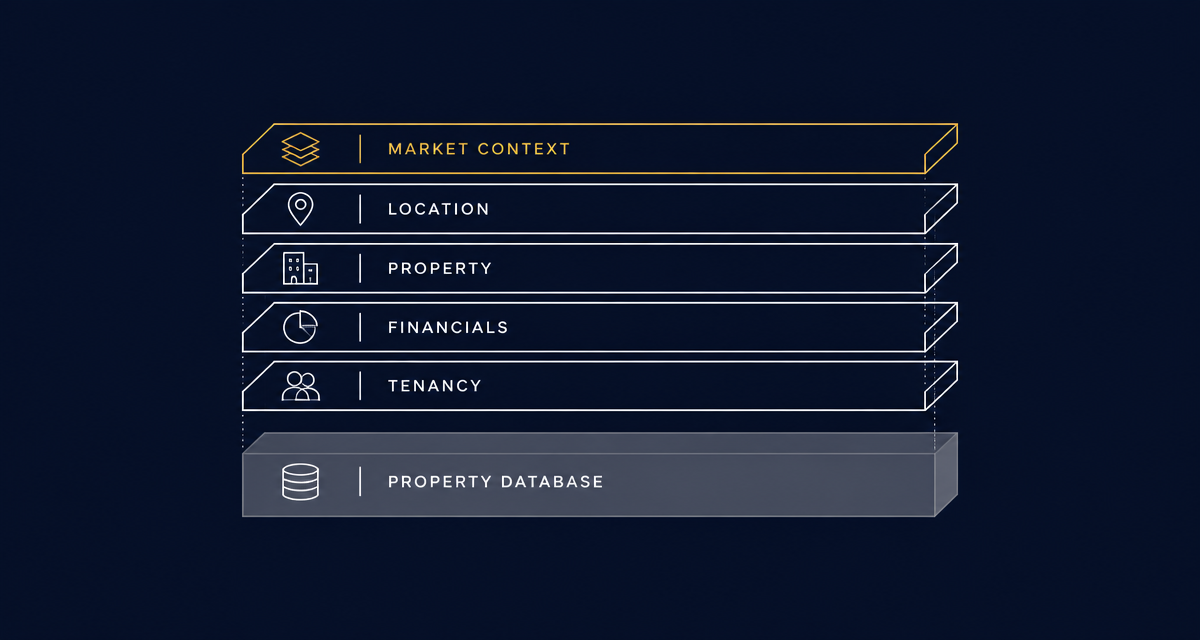
What five data layers does tenant representation actually need?
1. Occupier identity. The legal entity, the trade name, and the connection between them. This is harder than it sounds: in Washington State, 59.7% of registered businesses have a legal name that differs from their trade name, and business-license addresses are polluted by registered-agent addresses as a matter of statute. A platform that cannot resolve "the LLC on the lease" to "the company you would call" fails at step one.
2. Tenancy mapping. Which occupier sits in which building, ideally which suite, as of when. This is the layer no vendor measures publicly. Address-to-occupant matching is genuinely difficult (fewer than 1% of addresses in Seattle permit data carry a suite designator, for example), and no CRE data vendor publishes an address-to-occupant match rate. That silence is informative.
3. Lease events. Commencements, expirations, options, renewals. Some of this is licensable (comp databases), some is inferable (a tenancy that ends is a lease that ended), and much of it is proprietary to whoever did the deal. Any vendor claiming complete expiration data for a market is overclaiming; ask how much is modeled versus observed.
4. Ownership and counterparty. Who owns the building, through which entities, in what financial condition. This is where Reonomy-style ownership data serves the tenant side: your client's leverage depends partly on their landlord's position. We covered the broker workflow angle in our landlord counterparty risk piece.
5. Change signals. Permits, WARN notices, hiring surges, funding filings, sublease listings: the public exhaust that hints a tenant's space needs are changing. Signals are the most marketed layer and the least reliable one. A tenant improvement permit in Seattle, for instance, names a contractor but has no tenant field at all, and only a small fraction reference a future tenant by name. Signal without identity resolution is noise.
The order matters. Layers 1 and 2 are the foundation; signals are only useful once you know who is where. Most "AI-powered CRE intelligence" marketing sells layer 5 while quietly assuming layers 1 through 4 are solved. They are not.
What questions should you ask a vendor before buying?
Five questions separate a data platform from a demo.
First: what is your address-to-occupant match rate, and how did you measure it? No vendor publishes one. A vendor who answers with a measured precision figure, on your market, is showing you something rare. A vendor who answers with "our AI resolves entities with high accuracy" is showing you marketing.
Second: how do you handle suite-level granularity in multi-tenant buildings? Building-level occupier lists are easy and mostly useless for tenant rep; the unit of a deal is a suite.
Third: when your source data gets corrected or restated, does your platform show me the correction? Public records get backfilled and revised silently. A platform that cannot tell you what changed cannot be audited.
Fourth: what share of your lease-expiration data is observed versus modeled? Modeled expirations (estimated from typical terms) are fine as a prioritization heuristic and dangerous as a fact.
Fifth: can I export my own data out? Your deal history is your proprietary asset. A platform that ingests it and will not return it is a trap dressed as a tool.
Why not just build it yourself from public records?
Some brokers try: permits, licenses, WARN filings, assessor rolls, LLC lookups. The raw materials are public. The assembly is brutal.
We know because assembling exactly this, for Seattle, is BrokerHQ's core engineering problem. Business-license addresses that point to registered agents. Permit records with no tenant field. Entity names that differ from trade names six times out of ten. County records that attach tax data to owners, never tenants. Each source is individually public and individually misleading; the value is created in the resolution layer that connects them, and that layer is months of work per market, permanently maintained.
That is also why we think the category is worth building as a product. The public-record substrate for occupier intelligence exists, no incumbent has organized it tenant-first, and every individual broker who tries to do it alone rebuilds the same fragile pipeline. (What BrokerHQ ships today is the deal and tenant record system; the full signal layer described above is roadmap, and we label it that way deliberately.)
The operator take: the platform you are not offered is the one that matters
The absence of a mature tenant-rep data platform category is not an oversight. It is the market working as designed: data products get built for whoever writes the biggest recurring checks, and in CRE that has never been the tenant side. Tenant-rep brokerage has effectively been subsidizing landlord-side data infrastructure, paying CoStar rates for a database that treats the broker's actual asset, occupier knowledge, as an afterthought.
The consequence worth acting on: whatever occupier data you accumulate in your own book is scarcer than you think. Nobody sells a clean version of it. Structured client lease records, tracked outcomes, verified occupier-to-suite mappings in your submarket: that is proprietary data in the strictest sense, and it compounds if you store it somewhere queryable instead of in email threads. Buy tools where they exist. But treat your own deal record as the data platform's seed, because it is the one layer no vendor can sell you.
The honest counter-argument
The case against buying, or building on, a tenant-rep data platform in 2026 has real weight. The category is young: the products under this label are early, and an established CoStar seat plus a disciplined CRM covers a meaningful share of the need for a broker with a strong referral practice who prospects little. Incumbents are also moving toward occupier data (CoStar's lease-administration acquisitions point that way), and a broker could rationally wait for the incumbent version rather than bet on a new platform. And the hardest data layer, tenancy mapping, is unsolved by everyone, including the new entrants; early platforms will have gaps and errors, and a broker who treats their output as verified fact rather than prioritized leads will get burned.
Our answer to the last objection is the standard we hold ourselves to: platforms in this category should publish their match rates and mark modeled data as modeled. Until one does, including us, skepticism is the correct default.
FAQ
What is a commercial tenant-rep data platform?
A system of record organized around occupiers rather than properties: it identifies which companies occupy which space, tracks lease events and expirations, maps landlord ownership, and surfaces signals of coming moves. It differs from listing databases like CoStar or LoopNet, which organize data by property for the landlord and investment side.
Why doesn't CoStar work as a tenant-rep data platform?
CoStar is property-first: excellent for comps, availabilities, and building data, but occupier data is a byproduct rather than the product. Suite-level occupancy, verified occupier identity, and observed lease expirations across a market are not what a listing-side database is built to guarantee.
What data does a tenant-rep broker need that listing platforms don't provide?
Five layers: resolved occupier identity (legal entity to trade name), suite-level tenancy mapping, observed lease events, landlord ownership and counterparty condition, and change signals like permits and WARN notices, connected to the first two layers so they point at a nameable tenant.
Sources
- CRE Daily, "Best Commercial Real Estate Data Sources for 2026"
- Reonomy, "Commercial Real Estate Database: 2026 Guide to CRE Data Platforms"
- Washington Secretary of State business registry patterns; RCW 23.95.415 (registered-agent address statute)
- Seattle SDCI permit schema (public dataset field analysis)
- BrokerHQ research: entity-resolution and public-records source audit, 2026-08-17 (internal, methods available on request)
Disclosure: This analysis was AI-assisted using BrokerHQ's proprietary research corpus.
Liked this?
The weekly Seattle CRE Brief brings the same kind of read to your inbox every Friday. Subscribe, it's free.
Your deal record is the one data layer no vendor can sell you.
BrokerHQ keeps your market and deal data structured, sourced, and connected, so it compounds instead of scattering across your inbox.