Industry Education
What Is CRE Transaction Support? A Tenant-Rep Broker's 2026 Guide
CRE transaction support covers everything from signed LOI to occupancy and renewal: critical dates, milestones, commissions. What it means for tenant-rep brokers, which tools actually fit, and where the category falls short in 2026.
By Casey Krueger, Founder & CEO, BrokerHQ · Published August 30, 2026 · 9 min read
What does "transaction support" actually mean in CRE?
Ask five brokers what transaction support means and you get five answers, which is part of the problem. In practice, for a tenant-rep deal it covers the unglamorous middle and tail of the transaction.
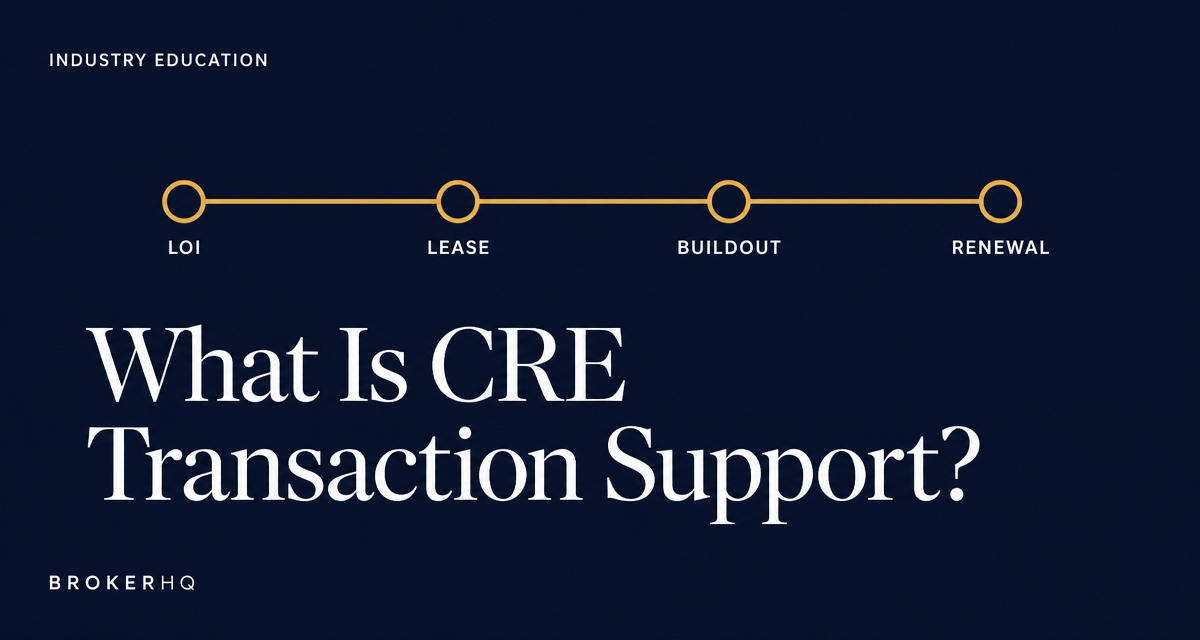
The work starts once the letter of intent is signed. The LOI is non-binding, but it sets the deal points that everything downstream has to honor: rent, term, TI allowance, options, possession date. From there the broker coordinates lease negotiation between the tenant's counsel and the landlord, tracks every open issue through redline cycles, manages the milestone chain (lease execution, permit approvals, TI buildout, substantial completion, possession, rent commencement), and reconciles the commission against what was actually signed.
Then comes the part most brokers drop: post-signing support. The executed lease contains a set of dates that will matter for the next five to ten years: renewal option windows, termination options, rent escalations, expansion rights, notice deadlines. Whoever tracks those dates owns the next transaction.
So transaction support splits into three phases: deal execution (LOI to lease signature), delivery (signature to occupancy), and lifecycle (occupancy to the next deal). Most brokers are diligent in phase one, inconsistent in phase two, and absent in phase three.
Why does transaction support eat so much broker time?
Because none of it lives in one place. The 2026 DNA of CRE report (Buildout and TheBrokerList's annual broker survey) found brokers use an average of seven separate software systems to manage the lifecycle of a single deal, and spend 46% of their time on administrative and manual tasks rather than client-facing work.
The deal file is an email thread, the critical dates are a calendar entry someone hopefully created, and the commission math is a spreadsheet.
Layer on deal duration and the cost compounds. Most office deals take months from requirement to signature, and the buildout phase adds more. A tenant-rep broker carrying eight active requirements is tracking dozens of open milestones across seven systems, and every status update a client requests is assembled by hand.
That is the quiet math behind the admin-time number: it is not one big task, it is hundreds of small reconciliations between systems that do not talk to each other.
What happens when transaction support fails?
The failure mode is almost always a date.
Lease critical dates (renewal option windows, termination notice deadlines, escalation triggers) are unforgiving. Miss a renewal option notice window and the client loses the below-market option they negotiated, or slides into an automatic renewal they did not want. Lease-management firms that clean up after these misses describe the consequences plainly: lost negotiation leverage, unwanted holdover or auto-renewal terms, and financial exposure that can run to six figures on a mid-sized office lease.
For the broker there is a second-order cost. The tenant who gets burned by a missed date does not blame the lease, they blame whoever they thought was watching it. And the broker who is not watching those dates also is not there when the renewal window opens, which is exactly when the client is deciding whether to run the next deal with the same broker or take the landlord's direct offer.
Critical-date tracking is simultaneously a risk-management function and a pipeline function. That dual role is why it is the single highest-leverage piece of transaction support to systematize.
What software handles CRE transaction support today?
The market splits into three camps, and it matters which camp a tool was built for.
Occupier-side lease administration. CoStar Real Estate Manager and Occupier are built for the tenant company itself: corporate real estate and finance teams tracking their own portfolio, often driven by ASC 842 lease-accounting compliance. Occupier can kick off renewal projects from critical dates in the portfolio. These are strong systems, but the buyer is the occupier, not the broker.
Landlord and investment-side deal management. Dealpath, VTS, and the enterprise suites (Yardi, MRI) manage acquisition pipelines and landlord leasing. Again, well-built, and again, not for the tenant-rep broker.
Broker-side platforms. AscendixRE (Salesforce-based, with commission tracking), Buildout's CRM and deal-management suite, and newer mid-market entrants like Quantix and MotionCRE aim at brokerages directly, with customizable pipelines and DocuSign-style integrations. Pricing in the mid-market tier starts under $200 per month. These get closest, but they are built around listings and dispositions first; tenant-rep transaction workflows (RFP rounds, TI milestone tracking, occupier-side critical dates) are usually a secondary fit at best.
The pattern: the further a tool sits from the tenant-rep chair, the better funded it is. The occupier tools have compliance budgets behind them. The landlord tools have institutional capital behind them. The tenant-rep broker has a spreadsheet. We tested which tools actually support tenant-rep workflows in a separate breakdown.
Why is tenant-rep transaction support still mostly manual?
Three structural reasons.
First, the buyer problem. A tenant-rep broker's transaction volume is lumpy and the fee arrives at signature, so software that manages the post-signature phase is managing work the broker has already been paid for. The economic incentive to buy it is weak, even though the relationship value of doing it is high.
Second, the data problem. Tenant-rep transaction support runs on data that lives inside documents: the LOI, the lease, the amendments. Until recently, getting critical dates and obligations out of a 90-page lease meant a human reading it. Software that just gives you empty fields to type into is not solving the actual bottleneck.
Third, the category problem. "Transaction management" as a software category grew up in residential (closing-document checklists) and in corporate lease administration (compliance). Neither ancestry matches what a tenant-rep broker actually does between LOI and occupancy, so brokers try the tools, find the fit poor, and go back to the spreadsheet.
The operator take: transaction support is a data problem before it is a workflow problem
What the category keeps missing: every valuable output of transaction support (the critical-date alarm, the milestone status report, the renewal pipeline) is derived from structured deal data. The workflow features are trivial once the data exists. The data is the hard part, because it is trapped in leases, amendments, and email threads.
That reframes the buy decision. The question is not "which transaction-management tool has the best checklist?" It is "where does my structured record of every deal live, and does it survive past closing?" A broker who captures every executed deal (parties, economics, options, dates) into a durable, queryable record is building two assets at once: a risk shield for current clients and a renewal pipeline that fires years into the future. The broker who does not is renting their own deal history from their inbox.
This is the thesis we build BrokerHQ around: the tenant-rep broker's compounding advantage is a structured, connected record of their market and their deals, with the workflow layered on top. Tools will come and go; the broker's own data layer should not.
The honest counter-argument
If you run four to six deals a year, a disciplined spreadsheet plus recurring calendar reminders genuinely covers most of this, and costs nothing. The failure cases above are mostly discipline failures, not tooling failures, and no software fixes a broker who does not maintain it. There is also a fair objection that post-signature lifecycle tracking is the client's job (or their lease administrator's), not the broker's, and a broker who over-invests in unpaid post-close service is subsidizing work the fee never covered. Both objections are right for some books of business. The counter is scale and memory: spreadsheets do not remind you in year four, and they do not compound across a hundred deals. The brokers who systematize this are not doing it for this deal, they are doing it for the next ten years of renewals.
Frequently asked questions
Is transaction support the same as transaction management software?
No. Transaction support is the work (coordination, tracking, reconciliation). Transaction management software is one way to organize that work, and most of it was built for occupiers or landlords rather than tenant-rep brokers.
What are the most important critical dates in an office lease?
Renewal option notice windows, termination option deadlines, rent escalation triggers, expansion or right-of-first-refusal windows, and rent commencement. The notice windows matter most because they expire silently.
When should transaction support start?
At the LOI. The LOI defines the deal points that every downstream document has to honor, so the tracking record should start there, not at lease signature.
Sources
- 2026 DNA of CRE report, Buildout and TheBrokerList (brokers use roughly seven software tools per deal; 46% of time on administrative and manual tasks), vendor-sponsored survey, attributed
- Occupier critical-date management guide; insightsoftware; Scribcor Global (missed critical-date consequences: lost leverage, unwanted auto-renewals, six-figure exposure on mid-sized leases), lease-administration vendor sources
- MotionCRE, "Best Deal Management Software for CRE (2026)" (mid-market deal-management pricing starting under $200 per month), vendor content
- Vendor product pages checked 2026-08-23: CoStar Real Estate Manager, Occupier, AscendixRE, Quantix, MotionCRE (product capabilities and category fit)
Disclosure: This analysis was AI-assisted using BrokerHQ's proprietary research corpus.
Liked this?
The weekly Seattle CRE Brief brings the same kind of read to your inbox every Friday. Subscribe, it's free.
Your deal history should be an asset, not an inbox search.
BrokerHQ keeps your market and deal data structured, sourced, and connected, so critical dates and renewal windows surface themselves instead of expiring silently.