How-To
How to Map Your Tenant-Rep Desk's High-Frequency Workflows Before You Buy Another AI Tool
By Casey Krueger, Founder & CEO, BrokerHQ · Published October 4, 2026 · 6 min read
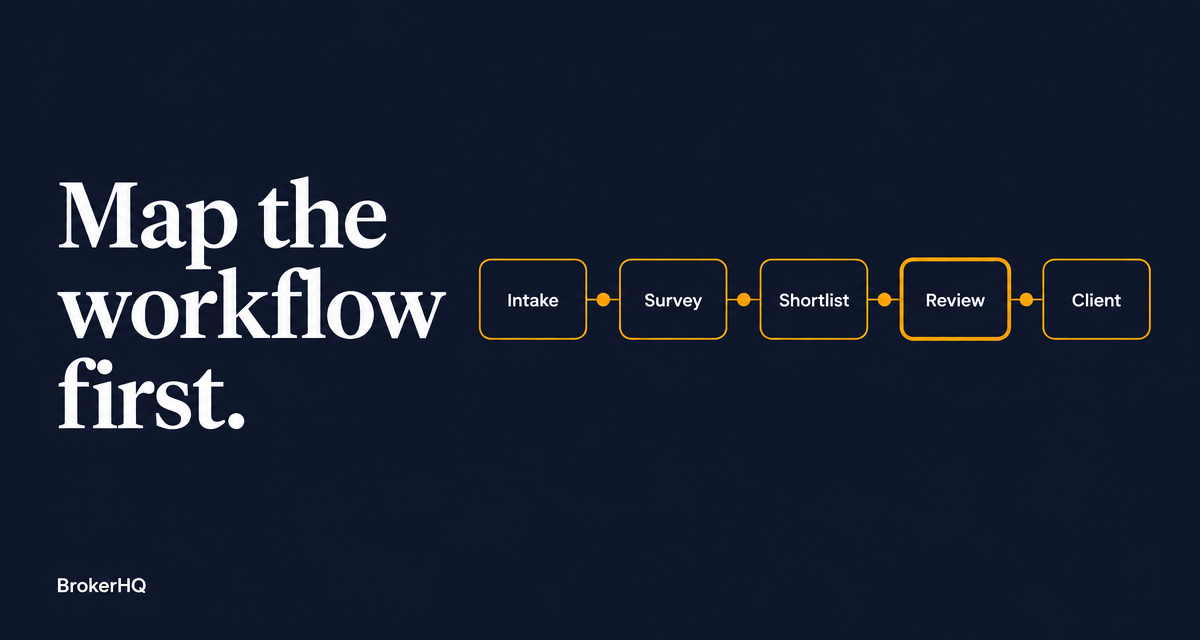
Why map workflows before choosing tools?
Tool-first adoption produces a familiar pattern. A document arrives, someone uploads it to a chat window, checks the output, and types the result into a CRM, a spreadsheet or a memo. The editorial describes it directly: "the human is actually still doing most of the integration work." Each new task needs another prompt, another upload and another transfer of context.
The editorial's recommendation is to ask a process question first: how do we reduce the work between receiving a new opportunity and deciding whether somebody should pursue it? It does not start with "how should we use ChatGPT?" It also does not dismiss the chat window: "Copy-pasting into ChatGPT can still be an excellent tool, in certain cases."
A tool that saves ten minutes on a task you do twice a year is not a strategy, and a tool that removes a hop from a task you do daily is.
I am adapting this from a piece aimed at a CRE lender, not a tenant-rep desk, so the six steps below are the editorial's structure and the tenant-rep application is mine.
What is the six-step shape of a connected workflow?
The editorial lays out the stages of a connected process: automated intake, information extraction into an agreed structure, comparison against firm criteria, filtering and prioritization, a human review gate before any consequential action, and supporting evidence attached throughout. Its stated principle is that employees stop acting as couriers between systems, which also makes human involvement more deliberate.
For a tenant-rep desk, the same stages read like this: a requirement or inquiry arrives, the facts are pulled into a consistent structure, the opportunity is compared against what you will and will not take, weak fits are set aside, a broker reviews before anything reaches a client, and the evidence behind each recommendation travels with it.
How do you find which workflows are worth connecting?
Use the frequency test from the editorial: tasks that happen weekly or more are candidates, tasks that happen twice a year create complexity without payoff. That threshold is the editorial's rule of thumb, not a measured study, but it is a useful forcing function.
Take one sheet of paper and do five things.
- List every task you repeat. Write down everything that happens at least weekly: intake of a new requirement, market survey, tour book assembly, landlord follow-up, lease abstract review, prospecting list updates.
- Count the hops. For each task, count how many times data moves by hand from one place to another, such as email to spreadsheet, spreadsheet to chat window, chat window to memo.
- Mark where context gets lost. Circle each hop where something the next step needs does not make the trip, like the reason a building was rejected or what the client said about parking.
- Place the review gate. Decide where a broker must look before work leaves the desk. For a fiduciary, anything client-facing is a gate: a shortlist, a rent number, a recommendation.
- Pick one. Choose the task with the most hops and the most lost context, and connect only that.
What does this look like for a new client requirement?
This is an illustration of the method, not a measured benchmark. Say a client sends a requirement: 12,000 square feet, a target submarket, a move date. The workflow from there tends to run: log the requirement, run a market survey, build a shortlist, assemble tour books, schedule tours.
Mapped honestly, the hops show up fast. The requirement lives in an email. The survey lives in whichever databases you pull from. The shortlist lives in a spreadsheet. The tour book lives in a document. Each transfer is a place where "why we dropped that building" can disappear. We have written about what market surveys and tour book assembly cost in hours, and the mapping exercise tells you which hop to remove first.
Data connectors make this more actionable than it was a month ago. CompStak launched an MCP server on September 29 that puts verified comps inside ChatGPT, Claude, Copilot and Gemini. Lofty, a residential brokerage platform, shipped one on September 30, and Rabbet did the same for project finance on October 1. If your survey step is a hop you can now remove, a connector is worth evaluating. If your painful hop is the one between the survey and the shortlist, a comp connector does not touch it, which is why you map first. For the vendor-side questions, see our post on what MCP means for a tenant-rep desk.
Where must a human stay in the loop?
At every point where work becomes a statement to a client or a landlord. A shortlist is a recommendation. A rent figure is a representation. The editorial puts the review gate immediately before consequential action, and for a tenant-rep broker the consequential action is almost always something the client will rely on.
The review gate belongs where your name goes on the output, not where the data was fetched. Our post on AI and broker liability goes deeper on why.
What is the honest counter-argument?
Mapping workflows takes time that a three-person desk may not have, and the exercise can become a project that never ships. The simplest defense is the scope: one sheet, one hour, one workflow chosen.
There is a second objection. Brokerage is relationship-driven, and the editorial itself notes that the business remains relationship-driven. Some of the highest-value work happens in a phone call that no workflow diagram captures. That is true, and it is the reason to automate the courier steps: so the time reclaimed goes to those calls, not to retyping.
Finally, the frequency threshold can mislead. A task you do twice a year but that costs a client a deal when it goes wrong may deserve a checklist even if it never deserves automation.
What should you do this week?
Do the one-page map for your single most frequent workflow. Count the hops, circle the lost context, mark the review gate. Then ask of each tool you already pay for whether it removes a hop you circled. If it does not, you have found either a gap or a subscription to question.
Frequently asked questions
Why map workflows before choosing AI tools?
Tool-first adoption leaves the broker moving data by hand between a chat window, a CRM and a spreadsheet. Mapping the workflow shows which hop is worth removing.
Which tenant-rep workflows are worth connecting?
Tasks that happen weekly or more, per the editorial's rule of thumb, such as requirement intake, market survey, tour book assembly and landlord follow-up. Twice-a-year tasks rarely justify the complexity.
Where must a broker review AI output?
Anywhere work becomes a statement to a client or landlord, such as a shortlist, a rent figure or a recommendation.
What are the five steps of the mapping exercise?
List repeated tasks, count manual hops, mark where context is lost, place the human review gate, and pick one workflow to connect.
Sources
- AI for CRE Collective (PLOT Daily), "Copy-pasting into ChatGPT is not an AI strategy," September 28, 2026.
- CompStak, "CompStak Launches Agent Connect, an MCP Server for Verified Commercial Real Estate Data," September 29, 2026.
- AI for CRE Collective (PLOT Daily): Lofty MCP server, September 30, 2026; Rabbet connector, October 1, 2026.
Liked this?
The weekly Seattle CRE Brief brings the same kind of read to your inbox every Friday. Subscribe, it's free.
See sourced intelligence on your market
Every claim linked back to the filing or record it came from.