Industry Education
Which Public Records Flag a Seattle Company About to Need Office Space?
By Casey Krueger, Founder & CEO, BrokerHQ · Published June 21, 2026 · 9 min read
Downtown Seattle office vacancy sat at 36.5% in the first quarter of 2026, up 350 basis points from a year earlier (Cushman & Wakefield). Seattle's office market now carries the highest vacancy of any major U.S. market. And yet the region posted its first positive net office absorption since the first quarter of 2022, about 253,000 square feet, led by the Eastside (Newmark). Both facts are true at once. Companies are still moving, expanding, and signing, even in the softest downtown in the country.
The question for a tenant rep is not whether demand exists. It is how to see a specific company's demand before the broker across the table does. That is a prospecting job, not a lookup job, and the best raw material for it is not on a listing platform. It is in the public record.
Why isn't the move-in signal in CoStar or LoopNet?
Listing platforms are built around supply. They catalog space that is available now, plus historical comps once a deal is done. That is genuinely useful, and for many roles it is the right tool. But a tenant rep wins earlier than that, by knowing which company is about to need space while the requirement is still forming inside the business.
A database answers the question you already know to ask. It will tell you what is available on Second Avenue. It will not tell you that a 40-person software firm in Pioneer Square just pulled a permit to build out a floor twice its current size, or that a California company just registered a Washington entity at a Bellevue address. Those are demand signals, and they surface in government filings long before anyone calls a broker.
Which public records flag a company about to need space?
Six streams do most of the work in King County and the surrounding markets. None of them require a paid data subscription.
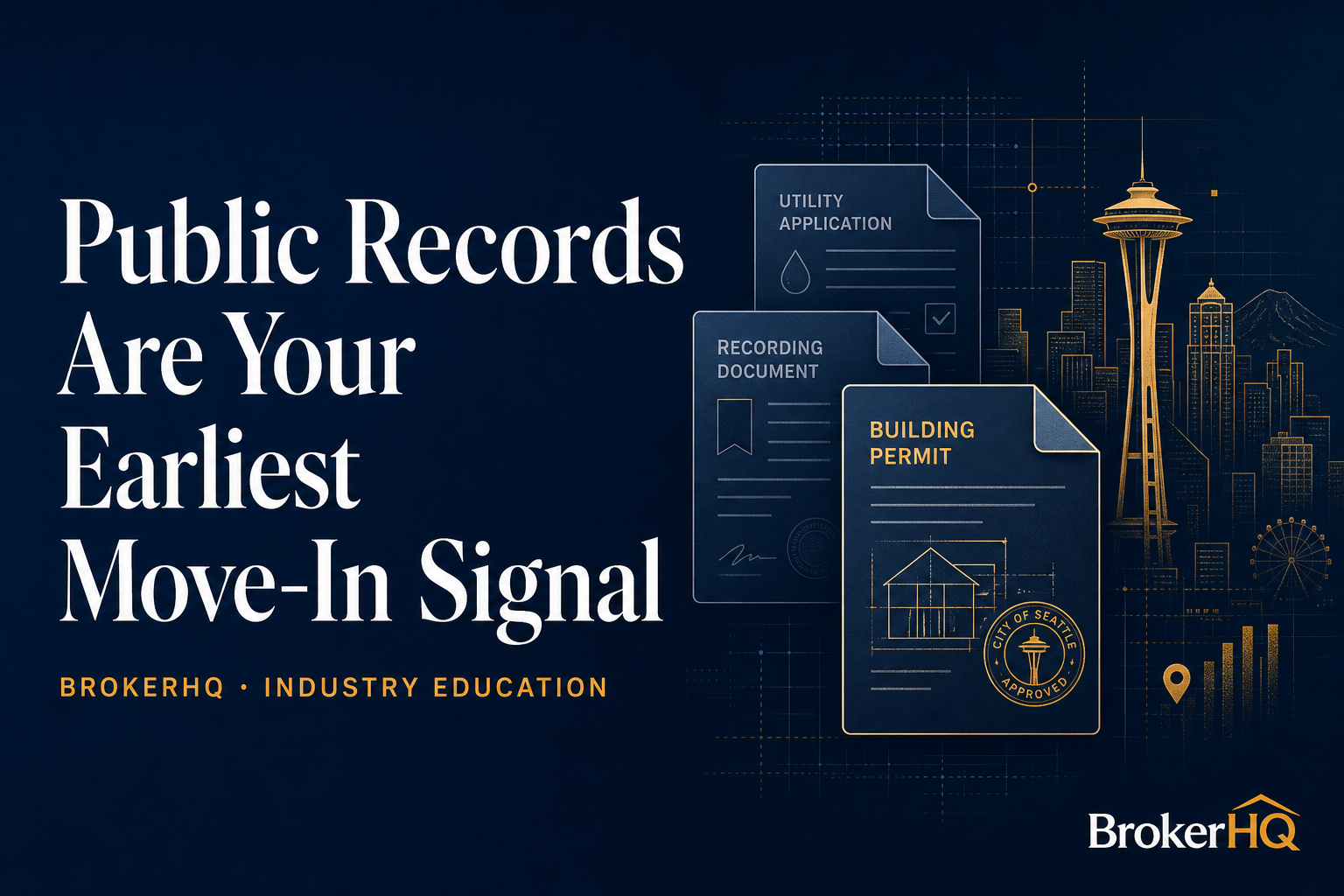
1. Commercial building and tenant-improvement permits. Seattle publishes its building permits as an open dataset, including the permit class, the project description, and the contractor company name. A commercial tenant-improvement permit is one of the strongest move-in signals in public data: a company does not pay to build out space it is about to leave. The description frequently names the incoming tenant, and the contractor field lets you follow one builder across multiple active projects. Bellevue, Redmond, Kirkland, and Bothell run their own permit portals, which matters because the Eastside is where the demand is concentrated right now.
2. New and changed business licenses. Seattle's active business-license dataset carries the legal name, the trade name, the NAICS industry code, the address, and the license start date. A new license at a commercial address, or a fresh start date paired with a recent permit, is a move-in confirmation. Industry code plus address lets you map which kinds of tenants are landing in which submarkets.
3. SEPA environmental filings. Washington's State Environmental Policy Act register captures larger commercial projects, with the applicant, the project description, and the determination. The applicant is often the developer or the end tenant seeking space, and a SEPA filing typically lands 12 to 18 months before occupancy. This is your longest lead-time signal, the one that tells you about demand a year out.
4. Federal contract awards and grants. USAspending.gov is a free federal API. A Washington company that just won a large defense contract or a multi-year research grant is a company about to add headcount, and headcount is what drives space. Joining an award to a company name and address turns a growth event into a prospecting lead.
5. New entity formations and annual reports. The Washington Secretary of State records new entities, their registered agents, their governing people, and a principal office address. An out-of-state company forming a Washington entity is often planting a flag before it leases. That pattern matters more than usual this cycle: most large AI leases in the region since 2022 came from companies headquartered elsewhere, the majority from California (JLL, via Connect CRE).
6. Court and bankruptcy records. Federal bankruptcy filings list a debtor's leases in their schedules, naming the property, the landlord, and the term. State court records surface lease disputes and unlawful-detainer actions. A tenant in distress is a tenant about to move, by choice or otherwise, and those filings are public.
How early does each signal fire?
Read them as a timeline, not a pile. The SEPA filing is the early warning, often a year or more out. New entity formations and federal awards sit in the middle, signaling growth before the space search is public. The tenant-improvement permit is the near-term confirmation, usually 3 to 6 months before people sit down at desks. The new business license lands around move-in itself. Stacked in order, these turn a vague sense that a submarket is heating up into a dated pipeline you can actually work.
What public data still can't tell you
Be honest about the gaps, because pretending they do not exist is how brokers lose trust. Private leases are almost never recorded in Washington, so a 6,000-square-foot office lease that never triggers a permit can stay invisible in public data. The broker's name is not recorded on commercial sales transactions anywhere in the state, so public records will not hand you a competitor's deal history. The ultimate owner behind an LLC is often shielded, since the federal beneficial-ownership registry is not public and Washington has no equivalent. And the single cleanest move-in signal, a new electricity account at an address, is customer-confidential and not available without the occupant's permission. Public-record intelligence gets you most of the way on public, government, nonprofit, industrial, and permit-triggering tenants. It does not get you everything.
Where's the legal line on using public records?
This part is not optional, and it is where a lot of well-meaning prospecting goes wrong. Washington's Public Records Act, at RCW 42.56.070, restricts using lists of individuals obtained from agencies for commercial purposes. Court rule GR 31 bars bulk distribution of court records for commercial solicitation of the people named in them. Some agency lists, including the state cannabis licensee lists, carry an explicit ban on commercial use.
The practical reading: analyzing property and business entities is permitted. Building a map of which parcels have active industrial permits, which addresses show new commercial licenses, or which buildings have SEPA projects in the pipeline is fair use of public data. Pulling a public agency's list of named individuals and cold-blasting them is not. The line is between intelligence about properties and companies, which is allowed, and bulk solicitation of named individuals, which is not. Stay on the property-and-entity side of it.
How should a Seattle tenant rep actually use this?
Treat the public record as a standing pipeline, not a one-time pull. Four moves.
Set a weekly read on the two or three datasets that match your patch. If you work Eastside office, that is Bellevue and Redmond commercial permits plus new entity formations. If you work industrial-adjacent or life-science, add the discharge-permit and federal-award streams. Consistency beats volume.
Lead with the signal, not a pitch. When you reach out, reference the actual public event: the permit, the award, the expansion. You are not cold-calling, you are showing up informed about something that already happened in public. That is the trusted-operator posture, and it converts.
Cross-check before you act. One signal is a lead, two stacked signals are a real requirement. A new entity formation plus a tenant-improvement permit at the same address is far stronger than either alone.
Keep the legal line clean. Use the data to understand properties and companies and to prepare. Do not turn an agency list of individuals into a bulk mailing. Precision here protects your license and your reputation.
The honest counter-argument
A skeptic would say this is a lot of unglamorous data work for signals that are noisy, lagging, and incomplete, and that a broker's time is better spent on relationships and referrals. That critique has real weight. Most of these records require effort to pull and join, none of them is a clean "this company needs 10,000 square feet" alert, and the biggest slice of private office demand never triggers a public filing at all.
The answer is not to treat public records as a replacement for relationships. It is to treat them as the reason you reach out before anyone else does. Relationships still close the deal. Public-record signals are how you earn the first conversation, by knowing about a company's move before it is on a listing platform. The work is real, and that is exactly why most brokers will not do it. The ones who do get there first.
The takeaway for tenant reps
The data that wins the next tenant-rep client is sitting in plain sight at the county and the city, unindexed and unsorted: permits, licenses, environmental filings, federal awards, formations, and court records. None of it is on a listing platform, because listing platforms track supply and this is demand. Read those streams on a weekly cadence, stack the signals, stay on the legal side of the line, and lead every outreach with the public event that prompted it. That is how a tenant rep sees the move before the market does, and being first is most of the job.
Sources
- Cushman & Wakefield, Seattle-Bellevue MarketBeat (downtown office vacancy 36.5%, Q1 2026): cushmanwakefield.com
- Newmark, 1Q26 Seattle office market report (regional positive net absorption, first since Q1 2022): nmrk.com
- City of Seattle Open Data, building permits (contractor company name, commercial class): data.seattle.gov
- City of Seattle Open Data, active business license tax certificate (NAICS, license start date): data.seattle.gov
- Washington Department of Ecology, SEPA Register: apps.ecology.wa.gov
- USAspending.gov, federal award data API: usaspending.gov
- Washington Secretary of State, Corporations and Charities (entity records): sos.wa.gov
- Connect CRE, Puget Sound AI leasing on pace for record year (out-of-market AI tenant share): connectcre.com
- Washington State Legislature, RCW 42.56.070 (Public Records Act, commercial-use limits): app.leg.wa.gov
- Washington Courts, GR 31 (access to court records): courts.wa.gov
Liked this?
The weekly Seattle CRE Brief brings the same kind of read to your inbox every Friday. Subscribe, it's free.
See the move before the market does, with the public-record signals already joined.
BrokerHQ stitches permits, licenses, formations, and federal awards into one tenant-rep pipeline, so the next conversation starts with a dated event, not a cold pitch.