Industry Education
What Is "Firm Memory" in CRE AI, and What Would It Mean for a Tenant-Rep Desk?
By Casey Krueger, Founder & CEO, BrokerHQ · Published September 20, 2026 · 13 min read
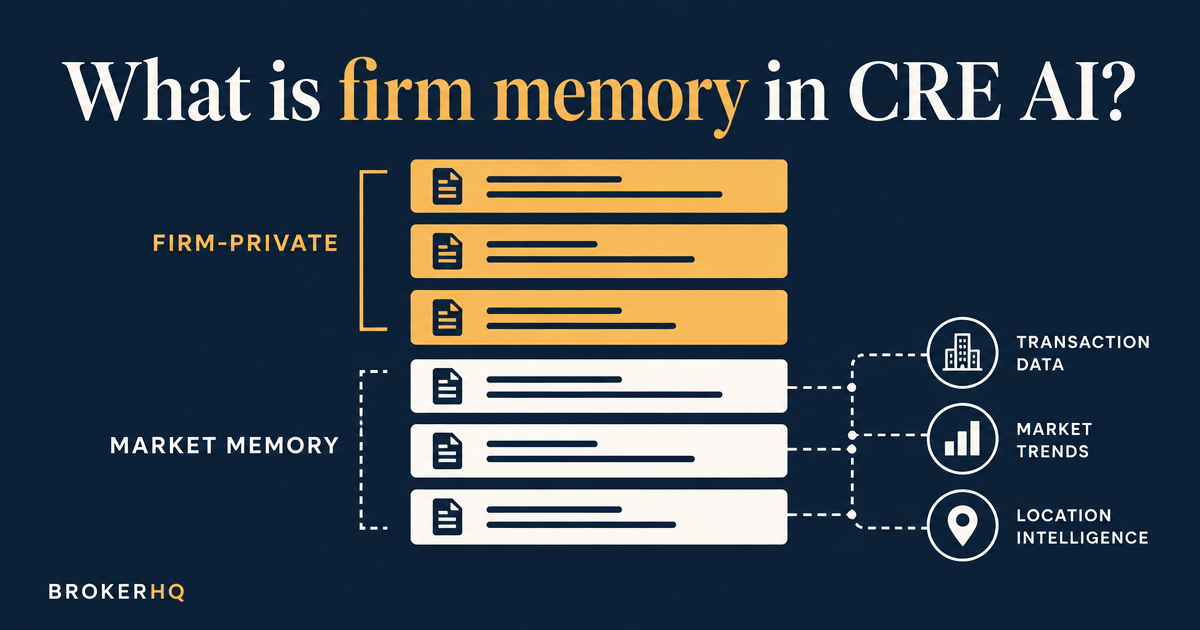
What does "firm memory" mean in CRE AI?
Strip the marketing and the idea is simple. A general-purpose model like Claude, ChatGPT or Copilot can read an offering memorandum and summarize it well. What it cannot do, on its own, is know that your firm looked at a similar building two years ago and passed because of flood exposure, or that your investment committee pushed back on the exit cap assumption last quarter, or that Fund III is not allowed to hold more than a set share of one submarket.
Spadafora's framing for PLOT Daily: "Horizontal tools like Claude, Copilot, and ChatGPT are excellent at summarizing an OM or drafting a DCF. But every session starts from zero." Firm memory is the layer that stops each session from starting from zero. In Intapp's case it is the Celeste agent platform wired to DealCloud, so a screening memo can flag that "a proposed cap rate is tighter than the last three deals the firm closed in the same submarket," or that a comparable property was rejected before. The record persists; the model consults it.
Intapp is careful to say the AI does not make the investment decision. The claim is narrower and, for that reason, more credible: "A copilot can help an analyst write faster. Firm AI helps a firm decide better, because it remembers what the firm has already learned."
Why did three vendors arrive at this in 2026?
Because the underlying models stopped being the differentiator. Two firms using the same frontier model get different results only if one of them feeds it years of decisions, terminology, permissions and outcomes. Intapp said as much: the models available to real estate firms "are becoming increasingly similar. What differs is the information surrounding them."
The same conclusion was reached independently on the practitioner side months earlier. In March 2026, Topher Stephenson's ChatCRE newsletter described a Dallas apartment GP who built a company knowledge base of interlinked markdown files in Obsidian and pointed Claude Code at it. Topher's summary of the idea: "stop re-explaining your company to AI every time you use it." That is firm memory built by hand, for one firm, by its principal.
And the complaint that drives both is the same one the AI for CRE Collective's mastermind surfaced in September, in the words of an operator running about 12 million square feet across office, life science, industrial, retail and data centers: "You can't be managing 12 MCP connectors." His data lived in MRI, ARGUS, Building Engines and SharePoint, and what he wanted was for staff to ask questions across all of it without granting everyone direct access to every system. The participants' name for the fix was a "central data layer," or an "ontology layer for mid-market CRE": this record maps to this property, to this tenant, to this lease, to this fund, to this source, to this permission.
So: model commoditization, a DIY movement proving the pattern, and a pain point articulate enough to name. That is why DealGround, Altrio and Intapp all arrived at "firm memory over a deal graph" within a few months of each other. We covered the DealGround and Altrio versions in our post on what MCP means for tenant-rep brokers.
What would a tenant-rep desk's firm memory have to remember?
Every one of those vendors sells to the owner or the investment-sales side, where the firm's memory is made of things the firm did: deals underwritten, assets bought, offers rejected. Translate that to a tenant-rep desk and the list looks different.
A tenant-rep firm's memory, if it existed as a queryable record, would hold:
- Every survey and tour book it ever built, tagged by tenant, submarket, size range and year. When the same tenant comes back at expiration, or a similar tenant appears, the last survey is the starting point, not a blank page.
- What each landlord actually did. Which ones retraded TI at the lease draft. Which ones delivered on time. Which asset managers returned calls. That is counterparty memory, and it is currently held in individual brokers' heads.
- What each client said they wanted versus what they signed. The gap between the stated program and the executed lease is the most useful training data a tenant-rep firm has about how its clients decide, and nobody writes it down.
- The outside signals that predicted a move. Which companies the firm tracked, which signals fired (a permit, a funding round, a WARN notice, a registered-agent change), and which of those tenants actually moved. Over a few years that record tells you which signals are worth watching in your market.
- Who the decision-maker turned out to be. At each client and each prospect, the title that actually owned the space decision, so the next outreach skips the guess.
Notice that four of the five are about what happened outside the brokerage. That is the difference from the owner side, and it is the reason the owner-side products do not transfer.
Why is the tenant-rep version harder to build?
On the owner side, memory is workflow exhaust. An acquisitions team that underwrites 200 deals a year generates 200 structured records without trying, because the underwriting model is the work product. Intapp's whole pitch depends on that: the firm already has "years of underwriting models, investment committee materials, pipeline records, and asset-level operating data" sitting in DealCloud. The memory layer just has to read what is already there.
A tenant-rep desk's work product is a survey, a tour, a proposal and a lease. Those are records of the deal, not of the market. The deciding information, which companies need space and when, was never inside the firm to begin with. So a tenant-rep memory layer has two jobs the owner-side version does not: acquire the outside data continuously, and resolve it to the right company, which in Washington means matching a business license, a Secretary of State entity, a lease footnote in a 10-K and a LinkedIn page that all spell the name differently. We wrote about why that identity problem, not storage, is the hard part in our post on what a CRE knowledge graph is.
There is a second structural difference. Owner-side firm memory improves the owner's own decisions, so the owner pays for it and keeps it private. Tenant-rep firm memory is partly about the market, and the market memory is worth more the more brokers contribute to it, which immediately raises the question every broker asks: who else can see this? On two separate demo calls this year, brokers told us they would not upload their firm's lease comps to any shared platform, regardless of the isolation guarantee, because the comps are the firm's competitive asset. Any tenant-rep memory layer has to separate firm-private memory (your surveys, your client history, your comps) from market memory (public signals, public filings, resolved identities) at the architecture level, and prove the separation, not assert it.
Can a broker build their own firm memory?
Yes, and some are. The Obsidian-plus-Claude-Code pattern Topher described is a real option for a principal who is comfortable with a folder of markdown files and a terminal. The AI for CRE Collective has run a paid workshop on exactly this ("Build Your AI Memory Layer"). For firm-private memory, the do-it-yourself version has an advantage no vendor can match: nothing leaves the building.
Its limits are the same as the owner-side products, in reverse. A markdown vault remembers what you put in it. It will hold your tour books and your landlord notes perfectly. It will not go get the 400 King County companies whose leases expire in the first half of 2028, and it will not notice when one of them files a new business license across the lake. The DIY path solves the inside half of tenant-rep memory and leaves the outside half where it is today, in a broker's browser tabs.
So the realistic architecture for a tenant-rep desk is a split: firm-private memory the broker controls (a CRM, a vault, a shared drive, whatever the firm already trusts) and a market-memory layer that acquires and resolves the outside data and hands it over in a form the private layer can use.
What rules should you hold any memory layer to?
Three came out of this month's operator reporting, and they apply whether the memory layer is a vendor product or a folder on your laptop.
Ask the AI where it found it. Cindy Mitchell, who leads lease administration transitions at Cresa, described her team's rule for every date and dollar value an AI extracts from a lease: make it show the passage. "You don't want to miss a date, because you'll cost your client millions of dollars if you do." A memory layer that returns an answer without a citation is a liability with a nice interface. For a tenant rep, the equivalent is: which filing, which permit, which license record says this company is moving?
Test 10 before you run 300. Cresa learned this after loading about 300 locations and discovering fields they should have included, then rerunning everything. Mitchell now starts with a small, varied set of leases, confirms the extraction is right, and only then scales. One client sent Cresa 15,000 files covering 90 locations. The lesson for anyone loading a tenant-rep firm's history into a memory layer: start with ten clients, check that the surveys, the landlord notes and the outcomes came through correctly, and only then load the archive.
Keep the CRM as the system of record. The Collective's mastermind consensus was that AI reads, extracts, compares and prepares; the existing spreadsheet or CRM stays the system of record and does the math; humans decide. Deeply nested AI-written spreadsheet formulas were called out as un-auditable. For tenant rep, this argues against any memory product that wants to become the CRM. The durable position is the layer underneath whatever the broker already uses.
The operator take
Firm memory is a real category and the owner side named it first. For a tenant-rep desk it splits in two, and the half that matters most is the half no owner-side vendor is building: continuous acquisition and resolution of the outside signals that decide who needs space, kept separate from the firm's private history and returned with the source attached.
That is the layer BrokerHQ is building, and it is worth being precise about what is live and what is not. Live today: company records assembled from Seattle business licenses, Washington Secretary of State filings, SEC filings (10-K, 10-Q, 8-K, Form D), WARN notices, permits, federal awards and H-1B filings, each field carrying a reference to its source; and a private enrichment path where a broker's own company list is tracked against those signals without the list being visible to any other account. Not live: a firm-private memory of the broker's own surveys, landlord history and client decisions. We think that half belongs to the broker's own systems, and that our job is to make the market half good enough that the broker never has to rebuild it by hand.
The test we hold ourselves to is the one Mitchell uses: every claim about a company should be able to answer "where did you find that?" with a document.
The honest counter-argument
For most tenant-rep teams, "firm memory" is a five-person shop with a shared CRM, a drive full of surveys and a senior broker who remembers every landlord in the submarket. That system works. It has worked for decades. Buying a memory layer to replace it is solving a problem the team may not feel, and the enterprise vocabulary (ontology, orchestration, deal graph) comes from a world of 12-million-square-foot portfolios and fund compliance rules, not a Bellevue office desk.
The counter to the counter is the senior broker. Salesforce's State of Sales data puts average sales-team turnover at 25 percent a year, and while brokerage tenure runs longer than software sales, the pattern holds: the firm's memory walks out with the person who holds it. On the owner side that risk is why Intapp exists. On the tenant-rep side it is why the firms that write things down outlast the ones that do not. Whether the writing-down happens in a vendor's product or in a folder the firm controls matters less than whether it happens at all.
Where we land: do not buy "firm memory" as a product category. Buy, or build, two specific things. A private record of what your firm did that your firm controls, and a market record of what companies did that someone else keeps current and can cite. Judge each by whether it answers "where did you find that?"
Frequently asked questions
What is "firm memory" in commercial real estate AI?
A persistent record of a firm's own deals, decisions, criteria and outcomes that an AI system consults before answering, so it does not treat each new opportunity in isolation. Intapp, DealGround and Altrio each shipped a version for owners and investment-sales teams in 2026.
Is firm memory the same as a CRM?
No. A CRM stores contacts and pipeline. Firm memory adds the reasoning and outcomes (why a deal was rejected, how an assumption performed) and makes it available to an AI at the moment of a new decision. Operators recommend keeping the CRM as the system of record and layering memory on top.
Do tenant-rep brokers need a firm memory layer?
They need two things: a private record of their own surveys, landlord history and client decisions, and a current, cited record of the outside signals that show which companies need space. Owner-side firm memory products address the first pattern for owners and neither half for tenant rep.
How should a brokerage evaluate an AI memory product?
Ask three questions from this month's operator reporting: does every answer cite where it found the information; can you pilot on ten records before loading three hundred; and does it leave your existing CRM as the system of record.
Sources
- PLOT Daily (AI for CRE Collective), "Intapp Brings Institutional Memory to Real Estate AI," September 18, 2026.
- PLOT Daily (AI for CRE Collective), "How Cresa Uses AI Beyond Lease Abstraction," September 18, 2026.
- PLOT Daily (AI for CRE Collective), "CRE Firms Need AI Infrastructure Before AI Products," September 14, 2026.
- PLOT Daily (AI for CRE Collective), "CRE AI Is Moving From Answers to Orchestration," September 17, 2026.
- Topher Stephenson, ChatCRE, "OpenClaw for CRE Prospecting + The AI for CRE Attorneys Program is HERE," March 19, 2026.
- Intapp, "Firm AI: A blueprint for the business of the firm."
- Altrio, "Altrio Connects AI to Investors' Most Valuable Deal and Market Data," PR Newswire, May 19, 2026.
- Salesforce, "New Research Reveals Sales Reps Need a Productivity Overhaul," State of Sales fifth edition, December 8, 2022.
Liked this?
The weekly Seattle CRE Brief brings the same kind of read to your inbox every Friday. Subscribe, it's free.