Industry Education
Is Henry AI Built for Tenant-Rep Brokers? What "Platform, Not Wedge" Means for a Seattle Office Desk
By Casey Krueger, Founder & CEO, BrokerHQ · Published September 13, 2026 · 12 min read
What did Henry AI actually announce?
Henry AI is a New York company founded in 2024 by Sammy Greenwall and Adam Pratt. Its first product built offering memoranda, underwriting and pitch decks for brokerage teams. On July 29, 2026 the company announced a $16.5 million Series A led by FirstMark Capital, with Thomson Reuters Ventures and Y Combinator among the participants, and launched Henry Deal at the same time.
The September 8 Commercial Observer piece by Cathy Cunningham is the first place the founders explained the reasoning on the record. Greenwall's framing was direct: "We needed to be a platform and not just a wedge product." Most customers knew Henry as a deck tool, so Pratt's team built a new platform from scratch in a sprint the founders describe as 45 to 60 days (elsewhere in the same piece, "35 days or so"), piloted it quietly inside enterprise brokerages, and only then announced.
Henry Deal covers underwriting, a comps database, market reports, buyer lists, lender lists and packaging through closing. The commercial results Greenwall gave Commercial Observer are worth quoting precisely because they are vendor-reported and unaudited: every existing customer who tried Henry Deal bought it, at roughly 30 to 40 percent higher pricing; more than 80 percent of net-new customers converted from pilot to paid; and new contracts are about twice the size of the old ones. The company also says it just signed its largest contract ever, with what Greenwall called "the largest office producer in this massive state."
Treat those figures as a founder's account to a trade publication. They are consistent with a real pull signal (FirstMark's Adam Nelson said the product was "really get[ting] pulled by brokers, even without a big sales team"), but no third party has verified them.
Why did the deck tool have to become a platform?
The interesting part of the story is not the fundraise. It is the two-part product thesis the founders spelled out.
The first part is "sell the outcome, not the tool." Pratt put it this way: "I'm not giving you a tool that helps you build decks faster. I'm giving you a deck. I'm not giving you a tool that makes your analysts do underwriting 20 percent more productively. I'm giving you a final underwriting model that you can send to a customer."
The second part is that every customer's workflow has to be bespoke. Greenwall on pre-AI software: "Before AI, software was really deterministic and programmatic, uncustomizable for that person's workflow. It was useless." Pratt: "If you give everyone the same one-trick pony, which is how traditional software is built, no one's paying for it."
Franklin Street's David Perlleshi, who leads investment sales there and came in as a pilot customer after a cold LinkedIn message from Greenwall, gave the customer-side version: a $1 million facility is packaged differently from a $20 million facility, a land deal differently from a lease-up. He said the platform helped his team's OM production "quadruple overnight," from one to two days per offering memorandum.
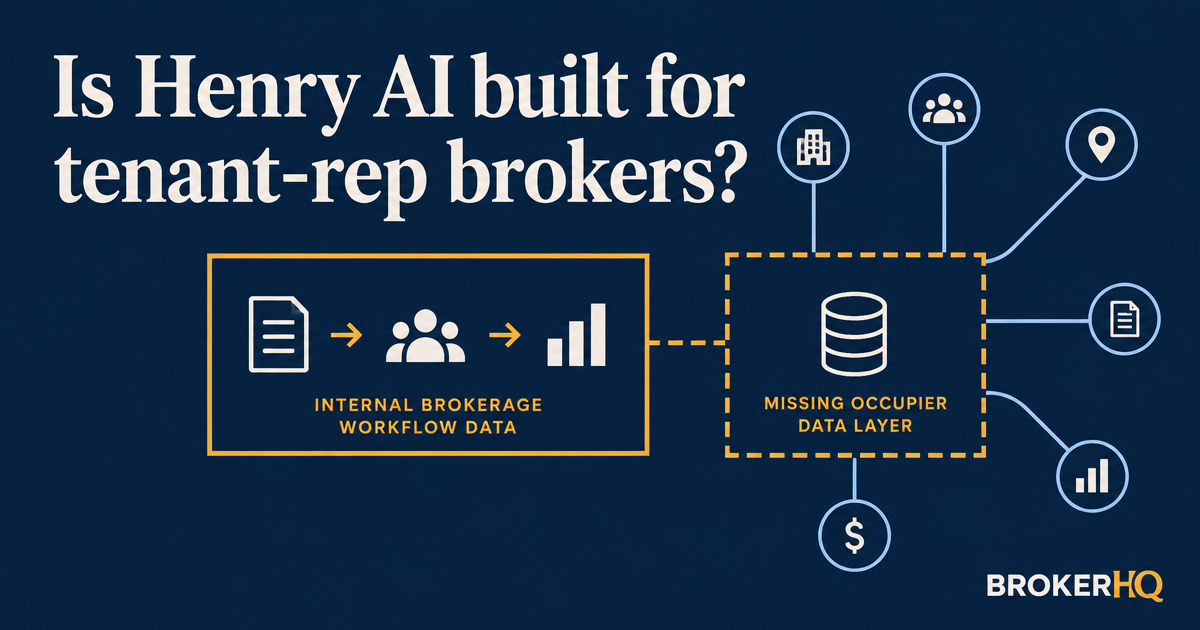
Notice what makes both halves of the thesis work. The outcome Henry sells (a deck, a model, a buyer list) is assembled from inputs the brokerage already controls: its listings, its comps, its prior underwriting, its buyer relationships. The bespoke workflow is possible because Henry's team has watched that brokerage produce hundreds of decks and learned its preferences. And the data moat the article describes, "taking all of Henry's customers' existing data and putting it into an organized box," is built from workflow exhaust. A multifamily team in Brooklyn building 60 decks a month with four comps each is generating 240 structured comps a month without trying.
That is a strong model for investment sales. It is the same model Altrio announced in May 2026 for institutional acquisitions teams, when it exposed its Origin deal platform to Claude and ChatGPT through the Model Context Protocol so a client could query years of its own deal history conversationally. Altrio's CEO Raj Singh described the asset the same way Henry does: a firm's "comprehensive, organized record of how they invest." We wrote about that pattern in our post on what MCP means for tenant-rep brokers.
Why doesn't the "organized box" transfer to tenant rep?
Because a tenant-rep desk's workflow does not generate the data that wins its deals.
An investment-sales team's most valuable records come from inside: what it listed, what it underwrote, who bid. A tenant-rep broker's most valuable records come from outside: which companies in the submarket are growing, which ones have a lease clock running out in the next 12 to 18 months, which one just pulled a tenant-improvement permit or filed a WARN notice or moved its registered agent, and who inside that company actually owns the space decision. That last one is harder than it sounds: CBRE Institute's research with CoreNet Global finds corporate real estate most often reports to the CFO, the COO or the CHRO, with the mix varying by industry, so the right contact is a different title at every company.
None of that lives in the brokerage's own deck history. You can run a tenant-rep team through Henry Deal for a year and the "organized box" at the end will hold your tour books, your proposals and your comps. It will not hold the list of the 400 King County companies whose leases expire in the first half of 2028, because nothing in your workflow ever produced that list.
The bespoke-workflow half of the thesis has the same problem in reverse. Henry can customize a deck because the customization is downstream of data the brokerage supplied. For a tenant rep, the hard customization is upstream: which signals matter for a 40-person software company on a five-year lease in Fremont versus a 300-person law firm in the Seattle CBD. That is a data-modeling problem before it is a workflow problem, and no amount of watching your decks teaches a vendor the answer.
There is a third gap the Commercial Observer piece makes visible by omission. Every quoted customer is on the sell side: Franklin Street investment sales, "the largest office producer" in a large state. An office producer is a landlord-side leasing broker. Henry is now saying "organized box of your data, then decisions" out loud, and it is aiming that at the side of the table that already has the data.
What does this mean for the Seattle market specifically?
Seattle is a market where the outside data matters more than usual right now, and where the inside data matters less.
Kidder Mathews counted 3.8 million square feet of Puget Sound office leasing in the first half of 2026, with the three largest Bellevue CBD deals going to OpenAI (247,000 square feet), Uber (168,000) and Databricks (160,000). Bellevue CBD leased about 6 percent of its inventory in the half against 2 percent for downtown Seattle. CBRE's 2026 Tech Gateway report puts Seattle among the five least AI-vulnerable major office markets, alongside San Jose, San Francisco, Washington, D.C. and Boston, and reports that tech took 21 percent of all US office leasing in the first half, a record share.
Read those together and you get a two-speed market where the winners are concentrated in a small number of AI and AI-adjacent tenants signing large Class A leases in Bellevue, while downtown Seattle stays a tenant's market. For a tenant-rep broker, the value of knowing which tech tenant is about to move, before the tour, goes up in that environment. The value of producing a prettier tour book goes up much less. A platform whose moat is your own tour books is optimizing the cheaper half of your job.
What should a tenant-rep broker ask a deal-platform vendor?
Five questions. They apply to Henry, and they apply equally to any vendor pitching "your data, organized, with AI on top" to a tenant-rep team.
- Where does your data come from? If the honest answer is "from what your team enters and uploads," the platform will be exactly as smart as your existing files. Ask what the vendor ingests from outside the brokerage, and for which geography.
- Who are your tenant-rep reference customers? Not brokerages that happen to have a tenant-rep group. Desks whose revenue is occupier-side. If the references are all investment sales and landlord leasing, the workflows were learned from the wrong side of the table.
- What is the unit of your database? A comp, a listing, a deal, or an occupier? Tenant rep needs the occupier as the primary record, with signals and contacts hanging off it. Property-first and deal-first databases can answer "what traded" and struggle with "who needs space."
- How do you handle King County's long tail? The institutional buildings are covered by everyone. Ask how many sub-5,000-square-foot suites under private landlords in your submarket carry a resolved occupier and a dated signal. If the vendor cannot answer with a number and a definition, the answer is "few."
- What happens to the "organized box" if you leave? Henry's thesis is that your accumulated data is the moat. Make sure it is your moat. Get export rights, format and cadence in writing before the pilot, not after.
The operator take
Henry AI's pivot is a legitimate result and a useful signal. It confirms that the market will pay meaningfully more for outcomes than for tools, and that vendors who watched real workflows for two years can deliver bespoke outputs the old software model could not. If you run an investment-sales team or a landlord-side leasing desk and produce a lot of decks, it is worth a look, and the 35-day rebuild is a reminder that AI has collapsed the cost of building workflow software. The workflow layer is no longer where the durable advantage sits, for Henry or for anyone.
For tenant rep, the lesson runs the other way. The durable asset in our business is the occupier graph, which is built from public records and outside signals, not from our own document history. BrokerHQ's position is that a tenant-rep platform has to start by acquiring and resolving that outside data, then generate the outputs (a shortlist, a tour book, a proposal) from it. That is why our priority is data acquisition, the knowledge graph and search rather than a nicer deck builder. We are not claiming to have solved the long tail of the King County lease clock; nobody has. We are saying that is the problem worth paying to solve, and a deck tool with an organized box does not solve it.
The honest counter-argument
The strongest case against this post is that Henry's model might transfer to tenant rep faster than we think. Three reasons.
First, tenant-rep desks do produce workflow exhaust: tour books, market surveys, proposals, lease comps and the notes a broker keeps about every client conversation. Organized well, that is a real proprietary dataset, and it is one Henry's approach could capture. Our post on why scattered tenant deal data costs brokerages deals makes that exact argument.
Second, the bespoke-workflow engine is data-agnostic. If Henry or a competitor licensed occupier data from a vendor and pointed the same customization machine at it, the gap we describe would narrow.
Third, the Series A gives Henry the budget to buy or build data. "Largest office producer in a massive state" is a landlord-side customer today, but office producers and tenant reps sit in the same firms, and the next expansion could be into the occupier side.
Where we still land: none of those three fixes exists yet, and the hard part of each is the outside data, not the platform. Until a vendor can show a tenant-rep desk the list of companies whose leases expire next year, with a resolved decision-maker attached, "organized box of your data" is a solution to the investment-sales problem wearing a general-purpose label.
Frequently asked questions
Is Henry AI a tool for tenant-rep brokers?
Based on the company's public statements and its named customers as of September 2026, Henry is built for investment-sales and landlord-side leasing teams that produce offering memoranda, underwriting and pitch decks. It does not describe an occupier-side data layer. Tenant-rep teams can use its deck and proposal tooling, but the platform's data advantage comes from sell-side workflow exhaust.
What is Henry Deal?
Henry Deal is Henry AI's end-to-end deal platform, launched July 29, 2026 alongside its $16.5 million Series A. It covers underwriting, a comps database, market reports, buyer and lender lists, and packaging through closing.
What does "platform, not wedge" mean in CRE software?
A wedge product does one job well enough to get adopted (a deck builder). A platform owns the workflow end to end and accumulates the customer's data along the way. Henry's founders say the platform rebuild, not the original wedge, is what drove their Series A and their pricing increase.
What data does a tenant-rep broker need that a deal platform does not provide?
Occupier-side signals: lease expirations, headcount changes, tenant-improvement and sign permits, WARN notices, registered-agent and business-license changes, and the identity of the executive who owns the real estate decision. Those are generated outside the brokerage and have to be acquired from public and third-party sources.
Sources
- Cathy Cunningham, "New York-Based Henry AI Has a New End-to-End Deal-Making Portal," Commercial Observer, September 8, 2026.
- Henry AI, "Henry AI Raises $16.5M Series A and Launches Henry Deal," PR Newswire, July 29, 2026.
- Altrio, "Altrio Connects AI to Investors' Most Valuable Deal and Market Data," PR Newswire, May 19, 2026.
- Kidder Mathews, "Seattle & Bellevue Office Leasing Activity 2026 YTD."
- CBRE, "2026 Tech Gateway Office Markets."
- CBRE Institute and CoreNet Global, "Managing Corporate Real Estate & Facilities: Leading and Emerging Practices," Chapter 3, Organizational Structure (2024).
Liked this?
The weekly Seattle CRE Brief brings the same kind of read to your inbox every Friday. Subscribe, it's free.