Industry Education
How Do Tenant-Rep Brokers Find Decision-Maker Contacts at Private Companies? What One Eastside Broker's Stack Shows
By Casey Krueger, Founder & CEO, BrokerHQ · Published September 20, 2026 · 14 min read
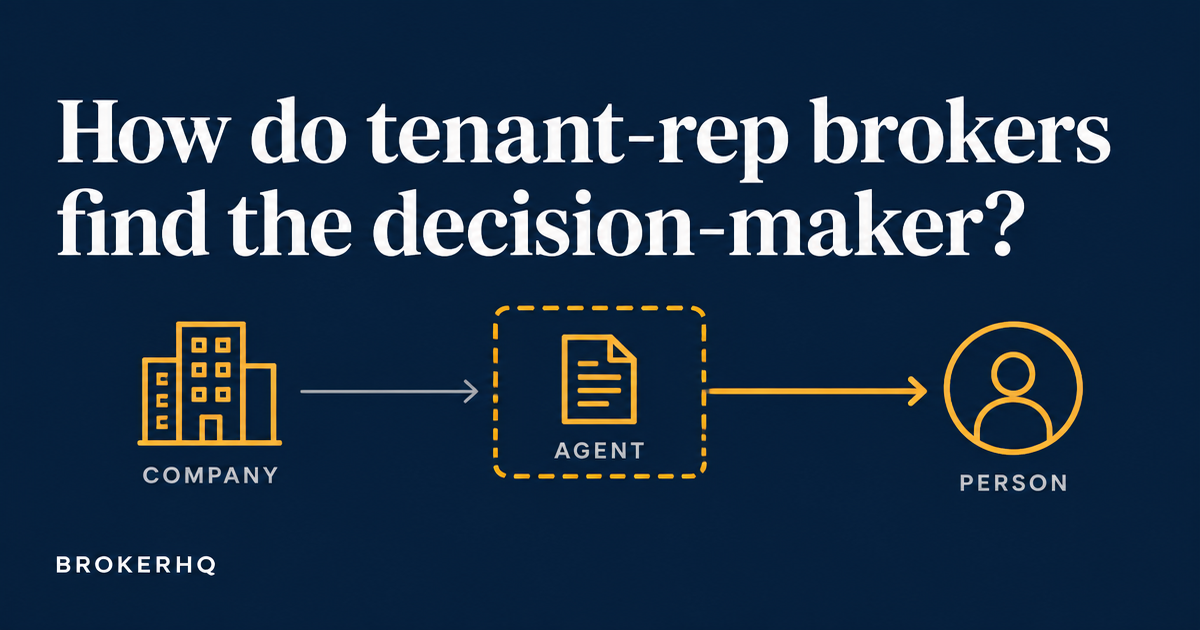
Why is contact information the bottleneck, not company discovery?
Ask a tenant-rep broker what slows down prospecting and the answer is rarely "I cannot find companies." Seattle and the Eastside have tens of thousands of licensed businesses. The bottleneck is getting from a company name to the person who owns the real estate decision, with a working phone number or email.
The broker on our call said it plainly: on the tenant-rep side, decision-maker names and contact information are "the most critical point for us," because making calls is where most of the time goes. Everything else he asked for (funding rounds, government grants, the ability to type "tech companies in Bellevue that raised over $10 million" and get a list) was a way to decide who to call. The contact was the thing that decided whether the call could happen at all.
That matches the broader sales data. Salesforce's State of Sales (fifth edition, 7,775 respondents) found reps spend just 28 percent of their week selling, with the rest consumed by deal management, data entry and research. Prospect research is a large slice of the 72 percent, and for a tenant-rep broker working private companies, most of that research is contact-finding.
What does a working broker's contact stack look like today?
Here is the stack he described, in his order, with what each source is actually good for in Washington.
Company websites. The obvious starting point. Good for a leadership page at companies large enough to have one. Weak for the private 10-to-60-person companies that make up the bulk of the tenant long tail, where the site may list no people at all. There is also a matching problem: the legal entity on a license or a Secretary of State record is often not the name on the website, so you cannot reliably get from a filing to a domain.
LinkedIn. Still the best directory of who works where and what they do. It will usually tell you who the COO, head of operations or office manager is. It will not give you a phone number, and cold InMail response rates are low enough that most brokers treat LinkedIn as a research tool, not a channel.
Washington Secretary of State (Corporations and Charities Filing System). Underused. Every Washington entity and registered foreign entity must file an annual report, and under RCW 23.95.255(2)(e) that report must state "the names of the entity's governors." Governors means directors of a corporation, managers of a manager-managed LLC, or members of a member-managed LLC. For a private company, the governors list is often the only public record that names the actual owners. It also lists the registered agent and the principal office address, which is how you tell whether the license contact is a real person at the company or a service.
People-search sites. He named Fast People Search. These aggregate phone numbers and addresses from public and commercial records. They are fast and often accurate for small-business owners whose personal and business lives overlap. The accuracy falls off quickly for anyone at a larger company, and the data is compiled for consumer lookup, not B2B verification. Nothing on those sites tells you whether the number belongs to the person who signs leases.
A colleague's Facebook account. He mentioned this half-joking, but it is the most honest line in the transcript. When public records and LinkedIn run out, brokers fall back to social graph: who knows this person, who is connected to them, who can make an introduction. That is a relational search, not a database search, and it is the part no vendor has replaced.
Nothing in that stack is wrong. The problem is that it takes five tabs and 20 minutes per company, and it produces a contact of unknown quality.
Why do business-license contacts break down above a certain company size?
City business-license datasets. Seattle publishes its license data openly. Bellevue publishes a business-license dataset on its open-data portal as well, and maintains a searchable business directory by UBI, legal entity or business name. Note that the Washington Public Records Act (RCW 42.56.070(9)) bars agencies from releasing lists of individuals for commercial purposes, so any vendor pulling license or assessor records for a commercial product has to work within that rule, typically by using entity-level data and declaring the use. The same statute is why you cannot legally build a marketing list from assessor owner names.
The practical consequence is a split. For small private companies, the license and the governors list get you to the owner directly, and the owner is usually the real estate decision-maker. For mid-sized and larger private companies, public filings tell you the company exists, where it is, and who its agent is, and nothing about who runs it. That is the gap the broker was describing, and it is the gap where the time goes.
Any data platform serving tenant rep has to do two things with that reality. First, classify the license and Secretary of State contacts into "person at the company" versus "agent or law firm," so a broker never wastes a call on a service. Second, for the companies that route through agents, find the decision-maker somewhere else.
Do the big contact-data vendors solve this?
Partly. ZoomInfo, Apollo and similar B2B databases hold executive names, titles, direct dials and emails for millions of companies, and for a private tech company with 100 employees and a website, they will usually have the COO. Brokers who use them get value from them. Three limits matter for tenant rep.
Decay. Contact data goes stale fast. Apollo's own published figure is that B2B data decays about 2.1 percent per month, or roughly 22.5 percent per year, and ZoomInfo's research puts the annual figure at 25 to 30 percent. Those are vendor-reported numbers about the vendors' own category, so treat them as directional, but the direction is not in dispute: a fifth to a third of the contacts in any list are wrong within a year, and the person who owned the space decision last year may not be there now.
Coverage of the long tail. These databases are built from web crawls, email signatures and user-contributed address books. They index well on companies that have a domain, a LinkedIn page and a marketing footprint. The 15-person engineering firm on a five-year lease in Redmond, registered as an LLC under a name that does not match its sign, is exactly the company they cover worst, and exactly the company a tenant-rep broker needs.
Wrong role. The databases know titles, not responsibilities. Who owns the real estate decision varies by company: at a 30-person firm it is the founder; at a 200-person firm it might be the CFO, the COO or the head of people. CBRE Institute's research with CoreNet Global finds corporate real estate most commonly reports to the CFO, the COO or the CHRO, with the mix varying by industry. A contact database will give you all three and let you guess.
So a broker with a ZoomInfo seat still ends up doing what the Eastside broker does: cross-checking against the Secretary of State, checking LinkedIn for recency, and asking around.
What can Washington public records actually give you?
More than most brokers use, if you know which record answers which question.
Who owns a private company. Secretary of State annual reports (governors list), as above. For an LLC, the governors are usually the members or managers, which for a small company is the owner. Cross-check the governor's name against LinkedIn and you usually have your decision-maker. We covered the hard version of this problem, where the owner is another LLC, in our post on LLC ownership tracing.
Who runs a public company. Public companies are the easy case for names and the hard case for reach. Executive changes are disclosed in 8-K filings (Item 5.02), officers are listed in the annual report and the proxy statement, and a growing number of 10-Ks and 10-Qs disclose lease terms and expirations in the leases footnote. The broker on our call was surprised that lease expirations could be public at all; for public companies they often are, and that was the signal that got him on the call. The catch is that a public company's named executives are not who a broker calls. You need the head of real estate or facilities, and that person is rarely in any filing.
Who at a company handles hiring paperwork. This one is obscure and useful. Employers sponsoring H-1B workers file a Labor Condition Application (Form ETA-9035) with the Department of Labor, and DOL publishes disclosure files that include an employer point-of-contact name, title, phone and email. It is not the real estate decision-maker, but it is a real person inside the company with a working number, at exactly the kind of growing tech firm a tenant rep wants to reach. Washington has a lot of them.
Where a company is and whether it moved. City business-license datasets. Seattle publishes its license data openly. Bellevue publishes a business-license dataset on its open-data portal as well, and maintains a searchable business directory by UBI, legal entity or business name. Note that the Washington Public Records Act (RCW 42.56.070(9)) bars agencies from releasing lists of individuals for commercial purposes, so any vendor pulling license or assessor records for a commercial product has to work within that rule, typically by using entity-level data and declaring the use. The same statute is why you cannot legally build a marketing list from assessor owner names.
Who owns the building. King County assessor records show the taxpayer, usually an LLC. The broker asked for a link from the taxpayer LLC to its Secretary of State record so he could click through and do his own lookup. That is the right design given the statute: the platform resolves the entity and links out, the broker does the commercial use himself.
What are permits actually good for?
The broker pushed back on permits harder than anything else, and he was right in a specific way that is worth writing down.
Tenant-improvement permits get filed after the lease is signed, because the tenant's contractor is the one pulling them. So a TI permit does not tell you a company is about to move; it tells you a company already committed. As a move signal it is late.
What he pointed out is that it is a good lease-timing signal. If a company's TI permit was issued in March 2022, its lease almost certainly commenced within a few months of that date, and if you know typical term lengths for that size of tenant in that submarket, you can estimate the expiration window. For private companies, whose lease terms are never public, permit date plus typical term is one of the few ways to put a company on a renewal calendar at all.
That reframes permits from "signal that fires" to "clock that starts." It is a smaller claim than most vendors make for permit data, and a more useful one.
What did the broker not want?
Two things, and both matter for anyone building or buying in this category.
He did not want to upload his firm's lease comps. His firm has a shared CRM and comps database that predates him, was vetted by the firm for security, and represents the firm's actual competitive advantage when pitching a tenant. His concern was not abstract; it was that another user of the same platform could see his comps. A "your uploads are private to you" answer did not move him, and he said so. This is the second broker to tell us the same thing on a demo. The lesson is that proprietary comps are a brokerage asset with governance attached, and the burden of proof on isolation is on the vendor, not the broker.
He did not want a building database. He understood immediately that a company-first product is not competing with CoStar, asked how tenant rosters are derived (license address matched to building), and moved on. Buildings are the landlord side's inventory. For tenant rep, the building is where a company happens to be; the company is the record.
What would a data platform have to do to actually fix this?
Working from his ranked list, and being explicit about what is live today and what is not:
- Classify every public contact as person or agent. Registered agents, law firms and filing services should be labeled as such so no broker calls one expecting an owner. (BrokerHQ: contact-role classification is in progress; today the license contact is shown with its source and not yet reliably filtered.)
- Pull the governors list into the company record. The Secretary of State annual report is the best public source of private-company owner names in Washington and belongs next to the license data. (BrokerHQ: Secretary of State data is ingested and linked to companies; the governors list surfaced as named decision-makers is roadmap.)
- Show funding and contract signals with the filing behind them. Form D for private raises, federal award data for grants and contracts, each with a link to the source document. (BrokerHQ: Form D and award data are ingested; consistent surfacing on the company page is being worked on, and the broker on this call could not find Form D on screen, which is fair feedback.)
- Use the broker's own network for the warm path. The most reliable contact at a mid-sized company is the one a mutual connection can introduce. A platform that takes a broker's LinkedIn connections export and returns "of your connections and their connections, who is closest to this company" is doing relational search on the broker's behalf, without sending anything. (BrokerHQ: prototype stage; it does not send or draft messages.)
- Answer list-building questions in plain language. "Tech companies in Bellevue that raised over $10 million in the last 12 months" should return a list, not a filter panel. (BrokerHQ: roadmap; search today is by company name, ticker or building address.)
- Link out where the law says link out. Building-owner LLC to Secretary of State record; assessor parcel to the county viewer. (BrokerHQ: live for parcels; entity link-out for owner LLCs is roadmap.)
Coverage caveat, stated plainly: license-derived tenant rosters are Seattle-city today. Statewide sources (Secretary of State, WARN, SEC, DOL) already cover the Eastside; Eastside license coverage is in progress and Bellevue's data requires a declared commercial use. The broker on this call works only Bellevue, Kirkland and Redmond, and said he would not use the product until that gap closes. That is the correct call for him, and it is a coverage problem, not a product-thesis problem.
The honest counter-argument
The strongest argument against building any of this is that the best contact data is relational, and a database cannot be relational for you. The broker's fallback of a colleague's Facebook account is not a joke; it is a warm-intro graph, and warm intros outperform every cold channel. A platform that gets the owner's name and direct dial right still hands the broker a cold call.
There is also a fair argument that this problem is already priced into the job. Tenant-rep brokers are paid, in part, for the relationships that make contact-finding unnecessary, and a broker who is good at it may not want the field leveled. And there is the possibility that decision-maker identification is a job for general-purpose contact databases plus a CRE-specific company layer, rather than something a CRE data vendor should try to own end to end.
Where we land: the relational half is real and should stay the broker's. The public-records half (governors lists, agent classification, permit-based lease clocks, filing-linked funding signals) is mechanical, currently done by hand in five tabs, and is exactly the kind of work a data layer should absorb so the broker's time goes to the relational part.
Frequently asked questions
How do you find the owner of a private company in Washington?
Search the Secretary of State's Corporations and Charities Filing System for the entity, open the most recent annual report, and read the governors list. Under RCW 23.95.255 the report must name the entity's governors (directors, managers or members). Cross-check the names on LinkedIn.
Why does a business license list a law firm instead of the company?
Because every Washington entity must maintain a registered agent (RCW 23.95.405) and many companies use their counsel or a commercial registered-agent service as that agent. The agent's name and address then appear on public filings in place of a company employee.
Are tenant-improvement permits a good signal that a company is moving?
No. TI permits are typically filed after the lease is signed, so they confirm a move that already happened. They are useful as a lease-commencement clue: permit date plus typical term length gives an estimated expiration window.
Do contact databases like ZoomInfo work for CRE prospecting?
They work best for companies with a web footprint and a LinkedIn page. Vendor-reported decay rates of roughly 22 to 30 percent per year and thin coverage of small private LLCs mean brokers still verify against public records and their own network.
Sources
- Washington State Legislature, RCW 23.95.255, "Initial or annual report for secretary of state."
- Washington State Legislature, RCW 23.95.405, "Entities required to designate and maintain registered agent."
- Washington Secretary of State, "Governors, Officers, Directors, Members, & Managers" (FAQ).
- Salesforce, "New Research Reveals Sales Reps Need a Productivity Overhaul," State of Sales fifth edition, December 8, 2022.
- Apollo, "How Do I Keep My B2B Contact Database Fresh and Avoid Data Decay?" (vendor-published).
- U.S. Department of Labor, Office of Foreign Labor Certification, LCA Program disclosure data and record layout.
- City of Bellevue Open Data, "Business Licenses (All)."
- CBRE Institute and CoreNet Global, "Managing Corporate Real Estate & Facilities," Chapter 3, Organizational Structure (2024).
- Broker interview: recorded BrokerHQ demo call with an Eastside landlord-rep and tenant-rep broker, September 14, 2026 (anonymized; quoted with paraphrase where the transcript is auto-generated).
Liked this?
The weekly Seattle CRE Brief brings the same kind of read to your inbox every Friday. Subscribe, it's free.