Industry Education
How Do You Reconstruct a Company's Office History in Washington? A Source-by-Source Guide for Tenant-Rep Brokers
By Casey Krueger, Founder & CEO, BrokerHQ · Published September 13, 2026 · 12 min read
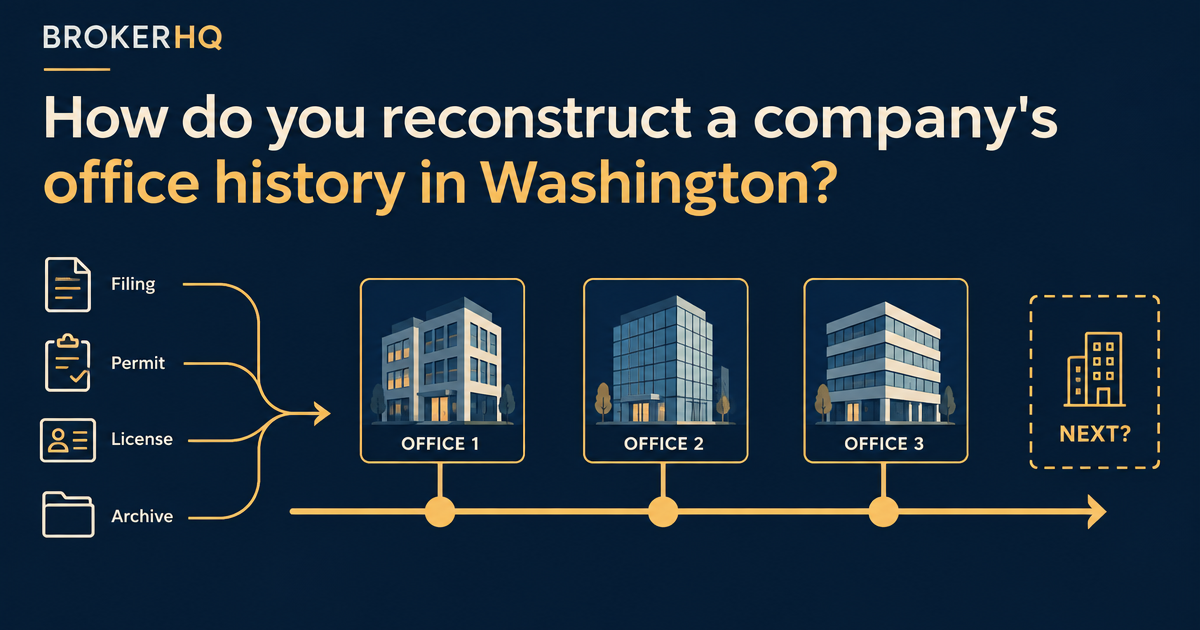
Why does a company's address history matter to a tenant rep?
Because the single most useful thing you can know about a prospect, other than its lease expiration date, is its pattern.
A company that has moved three times in nine years has a rhythm, and the next move is roughly datable from the last one. A company that has sat at the same address since 2011 is either locked in or about to be forced out, and the difference matters for how you approach it. A company whose registered agent, business license and website all changed address in the same quarter just completed a move, which tells you the next window is years away and that the useful conversation now is about the sublease of the old space, not the search for new space.
None of that is in a listing database, because listing databases record buildings, not occupiers. The occupier timeline has to be assembled from records that were never designed to be joined. The good news is that Washington and Seattle publish an unusual amount of it.
Which Washington state records anchor the timeline?
Start with the Secretary of State, because it gives you the one persistent key everything else can join on: the Unified Business Identifier, or UBI.
The Corporations and Charities Filing System (CCFS) at ccfs.sos.wa.gov shows every WA-registered domestic or foreign entity with its principal office address, mailing address, registered agent name and address, status and a link to its filing history back to formation. Each annual report and amendment carries a filing date and the addresses as of that date, so a company that has filed ten annual reports has given you ten dated address observations for free.
The live system shows the current snapshot with links to individual filings. For a full historical export on a target entity, you file a Public Records Act request with the Secretary of State keyed by UBI. Under RCW 42.56.520 the agency has to respond within five business days, either with the records, a link to them, or a reasonable time estimate. For a handful of named entities this is a low-effort request.
Two things to know about SoS addresses. The principal office is the legal headquarters, and companies sometimes leave it at a law firm or a registered-agent service for years after operations move. Foreign registrations (out-of-state companies registering to do business in WA) give you the date of a company's first Washington presence, which is a useful "arrived" marker for national tenants.
Second, the Department of Revenue's Business Lookup exposes business name, UBI, address, endorsements and status statewide. It is scriptable, and the endorsement dates bracket when the account was active. Treat it as the statewide backstop for a company outside Seattle city limits.
What does Seattle's business-license data add?
The city-level operating address, updated daily.
Seattle publishes its business license tax certificate data on the open data portal (data.seattle.gov), with a full Business License Tax Certificate dataset and an Active Business License Tax Certificate dataset. Fields include license number, business name, UBI, NAICS code, business location address and ZIP, and issue and expiration dates. Each location is its own row, so a company with a headquarters and a satellite office shows up twice.
This is the dataset that makes the timeline reconstructable rather than merely searchable. Because the export refreshes nightly, snapshotting it over time gives you a day-by-day record of which UBI was licensed at which address, and the license start and expiration dates tell you the interval even without snapshots. Where the SoS principal office says "legal HQ," the Seattle license says "where they actually operate in the city."
Bellevue, Redmond, Kirkland and most Eastside cities run their own license systems, several through the FileLocal portal. There is no unified free API, but each city responds to records requests, and the larger employment centers are worth the effort.
Which permits tell you when a company moved in?
Tenant-improvement and sign permits.
Seattle's Department of Construction and Inspections (SDCI) makes permit activity from 2005 to the present searchable by address or record number through the Seattle Services Portal, and launched a dedicated permit and site history research tool in July 2025. A TI permit carries the address, the applicant and contractor, a description that often names the tenant, the issuance date and the final-inspection date. A sign permit is even cleaner: nobody permits a sign for a suite they are not moving into.
The timing signal is good but not exact. Permit issuance usually precedes occupancy by weeks to months, and the final inspection is closer to move-in. King County's own permitting outside Seattle is tied to parcels and addresses rather than tenants, so it tells you a building had major work done and roughly when, but rarely who it was for.
Permits are the source that most often surprises brokers who think they know a building. A TI permit at a property you have not toured in two years is a new occupier you did not know about.
What do recorded documents and lien filings tell you?
Which private companies signed leases big enough to record.
King County's Recorder's Office puts most documents recorded since August 1, 1991 online through its Landmark Web search, indexed by party name, document type and recording date, with images for most. Memoranda of lease, UCC financing statements, mechanic's liens and deeds all carry party names and, frequently, the business's site or mailing address at the time of recording. Records before 1991 are on microfilm at the King County Archives.
For a tenant timeline, the recorded lease memorandum is the prize: it names the tenant, the landlord and the premises, and it is dated. Most small leases are never recorded, so the coverage skews to larger tenants and to landlords who insist on it. UCC filings are broader and, because equipment lenders record against the debtor's address, they are a decent corroborating source for where a company was operating in a given year.
How does the company's own website fill the gaps?
Through the Internet Archive.
The Wayback Machine at web.archive.org stores timestamped snapshots of most company websites going back to the early 2000s, and the Contact, About and footer sections usually carry a full street address at each crawl date. The last snapshot showing the old address and the first showing the new one bracket the move without any public-records request at all. The CDX API makes this scriptable across a list of domains.
Two supplements sit alongside it. Local business press (Puget Sound Business Journal, GeekWire, The Registry) covers named office moves with building names and dates, biased toward larger tenants. Corporate press releases announce relocations and expansions with addresses. Neither is systematic, but where they exist they are the most precise dating you will get.
How do you score confidence when sources disagree?
Weight the sources, then look for at least one change event.
A practical scheme, drawn from the research this guide is built on: give legal filings and city licenses the highest weight (Secretary of State, Department of Revenue, Seattle license), permits and recorded documents the next tier, news and press the same, and web snapshots the lowest. For each company-address-interval, count the independent sources that agree and sum their weights. An address supported by a SoS annual report, a Seattle license row and a Wayback snapshot in the same quarter is a high-confidence observation. An address supported only by a review site is a lead, not a fact.
When the SoS principal office and the Seattle license disagree over the same period, that is usually not an error. It is a company whose legal HQ stayed at counsel's office while operations moved. Split the timeline into a legal-address track and an operating-address track, and anchor every transition on at least one change event: a new annual report, a license address change, a TI permit at the new building, or a press item.
Then spot-check the method against companies whose moves were public. If your reconstruction of a GeekWire-covered HQ move lands within a quarter of the reported date, the pipeline is calibrated.
Where is the legal line in Washington?
At lists of individuals.
Washington's Public Records Act, RCW 42.56.070(9), prohibits agencies from giving, selling or providing access to lists of individuals requested for commercial purposes unless a specific law authorizes it, and agencies are expressly allowed to ask a requester's purpose. The Seattle City Clerk publishes a commercial-purposes declaration form for exactly this reason. The restriction is narrow in an important way: it applies to lists of individuals, not to business entities. A request for a company's filing history keyed by UBI is a request about an entity. A request for a list of registered agents sorted by name is a request for a list of individuals.
The operating rule for a brokerage is simple. Key everything on the entity and the UBI, keep owner and officer names out of anything you compile into a list, suppress residential-looking addresses for sole proprietors, and cache the derived facts (address, date, event) rather than bulk copies of source pages. Open-data portals generally license their datasets for reuse with attribution. News sites and review platforms do not license bulk scraping, so keep those lookups targeted.
The operator take
Everything above is free, public and legal, and almost nobody in Seattle tenant rep does it, because doing it by hand for one company takes an afternoon and doing it for a submarket takes a quarter. That is the gap BrokerHQ is built around. Our data-acquisition layer ingests these Washington sources, resolves them to a single company record keyed by UBI, and stores the dated address observations as a timeline, so that move cadence becomes a field you can sort by rather than a research project you schedule. The knowledge graph and search layers sit on top of that.
We want to be precise about what is live and what is not. Ingestion of state and county sources is an active build with an engineer on it, and coverage is uneven across sources and cities today. Reconstructing a timeline for any named company in King County is a capability we are building toward, not a button in the product this week. If a vendor tells you it has complete address history for every private company in the county, ask which of the sources above it ingests and how often.
The honest counter-argument
The case against investing in address history is that it is backward-looking, and a tenant rep is paid for the next move, not the last three.
That is fair, and there are two more objections worth taking seriously. Public records lag reality: a company can occupy space for a quarter before its license, its annual report and its website all catch up, so the timeline will always trail the truth. And the highest-value tenants, the ones signing 150,000-square-foot leases in Bellevue, are exactly the ones whose moves are covered in the press and known to every broker in town, so the reconstruction adds the least where the fees are largest.
Where we land: the long tail is the market. The 5,000-square-foot tenant under a private landlord is not in the press, is not in the listing databases and has no broker calling it. For that company, a reconstructed timeline showing a move in 2019 and a five-year cycle is the only forward signal available, and it is enough to put the company on a shortlist for a call in 2026. Backward-looking data is how you get a forward-looking list when nobody has the lease date.
Frequently asked questions
How do I find a company's previous office addresses in Washington?
Start with the Secretary of State's CCFS search by company name to get the UBI and the filing history, then check the Seattle business license open data for city-level addresses and dates, SDCI permits for tenant-improvement work at each address, and Wayback Machine snapshots of the company's contact page to bracket each move.
Is there a free source for Seattle business addresses over time?
Yes. The City of Seattle publishes business license tax certificate data on data.seattle.gov, with business name, UBI, NAICS, location address and license issue and expiration dates, refreshed nightly.
Can a broker legally use Washington public records for prospecting?
Entity-level records (company filings, licenses, permits) are public and usable. RCW 42.56.070(9) prohibits agencies from providing lists of individuals for commercial purposes, so keep compiled data keyed to business entities, not to named people.
How far back do Seattle permit records go online?
SDCI permit activity from 2005 to the present is searchable through the Seattle Services Portal. Older records are held on microfilm through SDCI and the Seattle Municipal Archives.
How far back do King County recorded documents go online?
Most documents recorded on or after August 1, 1991 are searchable online through the King County Recorder's Landmark Web portal. Earlier records are at the King County Archives.
Sources
- Washington Secretary of State, Corporations and Charities Filing System.
- Revised Code of Washington 42.56.070, Documents and indexes to be made public (subsection 9 on lists of individuals for commercial purposes).
- Revised Code of Washington 42.56.520, Prompt responses required.
- MRSC, "Exemptions and Prohibitions for Local Government Records."
- City of Seattle Open Data, "Business License Tax Certificate."
- City of Seattle Open Data, "Active Business License Tax Certificate."
- Seattle City Clerk, "Request for List of Names, Commercial Purposes Declaration."
- Seattle SDCI, "Research a Project, Permit, or Property."
- Seattle SDCI Building Connections, "Our New Permit & Site History Research Tool is Now Live," July 31, 2025.
- King County Recorder's Office, "Online records search."
- Internet Archive, Wayback Machine.
Liked this?
The weekly Seattle CRE Brief brings the same kind of read to your inbox every Friday. Subscribe, it's free.